The farms that worked — and then stopped
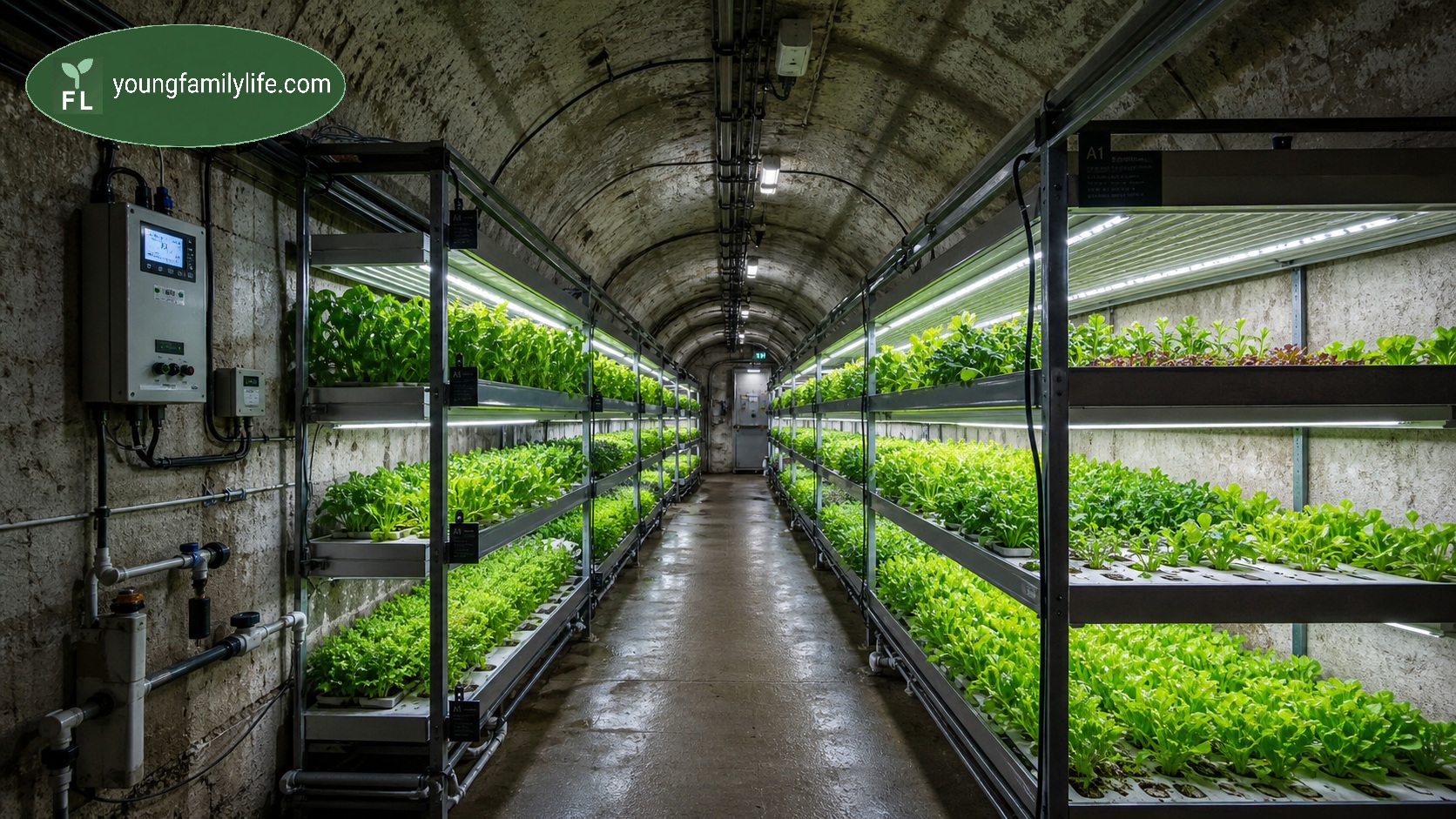
In 2015, a company called Growing Underground opened a food-growing operation 33 metres below Clapham High Street in south London, in a network of tunnels originally built as WWII air-raid shelters. Under LED lighting, in hydroponic trays stacked along the tunnel walls, it grew microgreens, salad leaves, and herbs — year-round, without pesticides, using around 70% less water than conventional field growing. Harvests came every ten days. Produce went to a market less than a mile away.
By every ecological measure, it worked. In November 2023, the company was dissolved.
Growing Underground was not a failed idea. It was a viable idea that dissolved in one of the most hostile economic environments of the decade. The pandemic emptied the city offices and restaurants it supplied. The Ukraine war's gas price spike drove electricity costs to extraordinary levels at precisely the moment the business needed stable operating costs. Interest rate rises increased the burden of the investment capital it carried. The consumer economy contracted around it. Any one of those pressures would have been damaging. All of them arrived within three years.
It was far from alone. Across the same period, comparable businesses collapsed across Britain, Europe, and the United States — companies that had raised hundreds of millions in investment and hit the same convergence of shocks. The technology worked in every case. The conditions did not.
This piece looks at how the electricity problem works, how it has been getting harder rather than easier — and what a technology currently under development might eventually change.
How electricity became the obstacle
Growing food indoors means no sunlight and no natural ventilation. Every element of the growing environment — lighting, temperature, humidity, CO₂ levels — is maintained by powered systems running continuously. The operation needs electricity available at all times, at a stable price, regardless of what the weather is doing outside.
That is precisely what solar and wind cannot reliably deliver. When the wind drops or the sun goes in, you cannot ask the lettuce to wait. The farm draws from the grid instead — which means paying whatever the grid is charging at that moment, often driven by gas generation. When energy prices spike, the entire cost structure of the business changes. That is what happened to Growing Underground and to the wave of comparable businesses that failed alongside it. The detail of why the grid works the way it does, and why storage solutions haven't yet resolved it, is in The Land That Heals Itself.
The problem has been getting harder, not easier
You might expect that as more renewable energy comes online, the electricity cost problem would gradually ease. The evidence in 2026 points the other way.
Artificial intelligence runs on data centres — enormous warehouses of computers that need vast amounts of continuous electricity. Demand from data centres jumped 17% in 2025 alone, far faster than electricity supply was growing. The biggest technology companies are spending hundreds of billions building more. In Dublin, data centres now use nearly 80% of the city's electricity.
These data centres need exactly the same thing vertical farms need: electricity on tap, at all times, whatever the weather. They are competing for the same grid capacity. A new indoor farm opening in 2026 is entering a tighter electricity market than the one that defeated Growing Underground — not a looser one. The grid is getting greener. It is not yet getting cheaper for users who cannot flex their demand.
This pattern has happened before
The story of pioneer businesses failing while leaving behind proven technology and usable infrastructure is not new. The Railway Mania of the 1840s saw hundreds of railway companies floated on speculative investment. Most went bankrupt before completing their lines. The capital was lost. The physical infrastructure — the track, tunnels, cuttings, and stations — remained, and later operators built the Victorian railway network on foundations the failed pioneers had literally laid.
The Metropolitan Railway — the world's first underground passenger railway, opened in London in January 1863 — followed the same pattern over a longer arc. Early operators were financially precarious. The technology (steam locomotives in underground tunnels) was expensive, unreliable, and produced conditions that were, by any measure, unpleasant. The commercial case for underground transit was far from obvious to investors for decades. What the Metropolitan Railway demonstrated was that the idea worked — that tunnels, once built, had a utility that outlasted any individual operating company. Electrification in the early twentieth century resolved the technology problem that steam had represented, and transformed a struggling pioneer into the foundation of a network that would carry over a billion passengers annually.
The vertical farming wave of 2019–2023 maps onto this pattern. Large capital inflows, overextended valuations, widespread insolvency — and surviving infrastructure, documented engineering, and demonstrated proof of concept. Growing Underground proved that food could be grown at commercial scale in underground urban space, without pesticides, with dramatically reduced water use. Zero Carbon Farms inherited the tunnels and the knowledge. The question is whether the conditions that defeated the first generation of operators will have changed sufficiently for the second. For the Metropolitan Railway, the transforming condition was electrification. For controlled environment agriculture, the equivalent is the cost and consistency of electricity supply.
The energy source that would change the picture — but is not here yet
The energy source that would, in principle, resolve the problem is magnetic confinement nuclear fusion — generating electricity by fusing hydrogen atoms together in plasma held by powerful magnetic fields, at temperatures around 150 million degrees Celsius. Unlike fission, the nuclear technology currently generating electricity in power stations around the world, fusion produces no long-lived radioactive waste, carries no meltdown risk, and is fuelled primarily by deuterium extractable from seawater — effectively limitless. A landmark experiment at the National Ignition Facility in December 2022 confirmed the physics work as predicted. The challenge that remains is engineering and capital, not physics. By mid-2025, 53 private companies had raised approximately $9.77 billion toward that challenge, with the first grid-connected commercial electricity most plausibly a decade or more away.
The solar learning curve is the most instructive comparison: solar electricity costs fell by approximately 90% between 2010 and 2020 as manufacturing volumes scaled. Whether fusion follows a similar trajectory — from expensive first-generation plants to broadly competitive electricity — is unknown, but the direction of travel is a reasonable expectation once commercial deployment begins. What fusion would mean for energy geopolitics, for who holds leverage over the technology, and for humanity's resource base beyond Earth is a larger story than this piece carries. In Other Words: Fission and Fusion — Two Ways of Getting Energy from Atoms examines it in full.
How this connects to land recovery
The connection is straightforward. British farming has been intensively managed for 80 years — maximum food from maximum land. The ecological recovery now visible on rewilded estates like Knepp in West Sussex and Somerleyton in Suffolk is only possible because those estates removed land from that pressure. But removing land from food production only works if the food gets grown somewhere else instead.
Controlled environment agriculture — food grown in urban facilities rather than fields — is one answer to where that somewhere else might be. If the electricity cost problem is eventually resolved, a meaningful shift of food production off land becomes possible. What land does when that pressure reduces is what The Land That Heals Itself explores in full. The ecological recovery timescales involved — decades, not years — mean that a fusion-powered energy landscape arriving in the 2030s would not be too late to matter.
Whether that sequence plays out is not yet knowable. The trajectory is more credible in 2026 than it has ever been. It is not yet a plan.
Topics: #InOtherWords #EnergyAndFood #VerticalFarming #ControlledEnvironmentAgriculture #NuclearFusion #RenewableEnergy #FoodTechnology #LandHusbandry #BritishFarming #NaturalHealing #NatureAndHumanExperience #YoungFamilyLife
Related YFL Content
In Other Words: The African Grain Story — A parallel case of Stage 1 intervention sustained without the conditions for recovery: how food aid created the dependency it was designed to bridge.
In Other Words: The Market Problem — How profit decides what gets grown and where — why the price on the label is not what food costs, and what that means for anyone trying to farm differently.
In Other Words: Fission and Fusion — Two Ways of Getting Energy from Atoms — The physics made plain — and the consequences followed outward: what fusion is, how it differs from fission, who would hold leverage over the technology, and what it would mean for humanity's resource base beyond Earth.
Natural Healing: Understanding Recovery Across Physical, Psychological, and Therapeutic Domains — The companion essay that established the recovery framework this series applies to land — beginning with how a broken bone heals.
Copyright Notice
© 2026 Steve Young and YoungFamilyLife Ltd. All rights reserved.
"In Other Words" is a copyrighted content format of YoungFamilyLife Ltd.
The information in this piece is based on established research and theory. Full academic sources, references, and evidential detail are available in the linked YoungFamilyLife essays.
This essay was developed collaboratively using AI assistance to research academic sources and refine content structure, while maintaining the author's original voice, insights, and "Information Without Instruction" philosophy. No part of this essay may be reproduced, distributed, or transmitted in any form or by any means, including photocopying, recording, or other electronic or mechanical methods, without the prior written permission of the copyright holders, except in the case of brief quotations embodied in critical reviews and certain other noncommercial uses permitted by copyright law.
For permission requests, contact: info@youngfamilylife.com