Two processes, one name — and consequences that reach further than energy
The question of where humanity gets its energy from — and indeed its resources — in the coming decades is one of the most consequential open questions of this century. It touches everything: the climate, the cost of living, the viability of technologies that depend on cheap and consistent electricity, the geopolitics of who controls fuel supplies, and the basic question of whether the transition away from fossil fuels can happen at the pace and scale the evidence suggests it needs to. But energy and resources are not separate questions. They are the same question asked from different directions. The resources humanity can access are determined, fundamentally, by the energy available to reach and process them. Change the energy picture profoundly enough and the resource picture changes with it — including resources that are not on this planet at all.
Throughout human history, civilisations have risen and declined in direct proportion to the energy sources available to them. Wood gave way to coal, coal to oil and gas, each transition expanding what was possible, who held power, and where the boundaries of the accessible world lay. Every transition also restructured leverage: the nations and interests that controlled the new energy source acquired a form of power that the previous order had not possessed and could not easily contest. The current transition — away from fossil fuels, toward renewables and potentially something more — is following the same pattern. What is not yet clear is which technology will define the next order, or who will control it.
Nuclear energy sits at the centre of that uncertainty in an unusual way. It is simultaneously one of the most established low-carbon electricity sources available — generating around 10% of the world's electricity today — and one of the most contested. Public associations with nuclear power are shaped primarily by its most visible failures: Chernobyl, Fukushima, unresolved waste storage, the slow and expensive construction of new reactors. Those associations are not inaccurate for the nuclear technology most people know — fission. What they do not describe is a second nuclear process — fusion — that draws on the same underlying physics but produces a fundamentally different result, and carries consequences that extend well beyond the electricity market.
Fusion has been under serious scientific development for 70 years. For most of that time it remained perpetually a decade away from commercial viability — a running joke among energy researchers. That characterisation is becoming harder to sustain. Private investment has reached $9.77 billion across 53 companies. The physics were confirmed by a landmark experiment in 2022. Multiple companies are now targeting grid-connected electricity within the next decade. If they succeed, the consequences will not be confined to the energy sector. They will reach into geopolitics, into the economics of resource extraction, and — through the combination of fusion energy and autonomous systems — into questions about humanity's relationship with the rest of the solar system that have previously been the territory of speculation rather than engineering.
This piece begins with the physics — plainly, with no background assumed and no mathematics involved. It then follows the consequences outward. The question it starts with is straightforward: if fission and fusion are both nuclear, why are they so different? The question it ends with is considerably larger.
Where the energy in atoms comes from
Everything is made of atoms. Atoms have a central nucleus — a dense core containing particles called protons and neutrons — surrounded by electrons. The nucleus is held together by a force that operates only at very short range but is extraordinarily strong within that range. Physicists call it the strong nuclear force, but the name matters less than what it does: it holds the nucleus together against the tendency of the positively charged protons to repel each other.
Holding things together requires energy. Releasing what was held together releases that energy. This is where nuclear energy — in both fission and fusion — comes from. Not from burning anything. Not from any chemical reaction. From the energy that was stored in holding atomic nuclei together.
The two processes release that stored energy in opposite ways.
Fission — splitting what is large
Nuclear fission, which is the basis of every nuclear power station currently operating in the world, works by splitting large, heavy atoms apart.
The atoms used are typically uranium or plutonium — both naturally occurring elements with very large, unstable nuclei. When a neutron strikes one of these large nuclei, the nucleus splits into two smaller fragments and releases energy — along with additional neutrons, which go on to strike other nuclei, causing further splits. This chain reaction, controlled carefully inside a reactor, produces sustained heat. That heat boils water, the steam drives a turbine, and the turbine generates electricity. The energy source is the nuclear force that was holding those large, heavy nuclei together.
The practical advantages of fission are significant. It produces no CO₂. It generates very large amounts of electricity from a small volume of fuel. It is available continuously, regardless of weather, which makes it dispatchable in a way that solar and wind are not. The UK's existing nuclear power stations provide approximately 15% of the country's electricity on this basis.
Hydroelectric power shares fission's dispatchability and is worth noting here as the one major renewable that also generates on demand. In its pump-storage form it functions as a grid-scale battery: when electricity supply outstrips demand, surplus power pumps water uphill into a reservoir; when demand spikes, that water is released through turbines to generate electricity. Dinorwig in Snowdonia — capable of reaching full output in under 16 seconds — is one of the most responsive large-scale storage facilities in Europe. The constraint is geographic: pump-storage hydro requires specific topography, reliable water supply, and substantial civil engineering. Suitable sites in the UK and across much of Europe are largely already developed. It is a valuable and underappreciated component of a resilient grid; it cannot scale to meet the demand trajectory the following sections describe.
The practical disadvantages are also significant, and they are the ones most people associate with nuclear power. The uranium and plutonium used as fuel are themselves radioactive and require careful handling. The fission process produces radioactive waste — the smaller fragments left after the nucleus splits — that remains dangerously radioactive for timescales that dwarf recorded human history. Some fission waste remains hazardous for tens of thousands of years. Storing it safely, in ways that will remain secure across those timescales, is an engineering and political challenge that no country has yet fully resolved. Accidents — Chernobyl in 1986, Fukushima in 2011 — have demonstrated what happens when reactor containment fails, and have shaped public perception of nuclear energy in ways that persist regardless of how much reactor technology has improved since.
It is worth noting that large-scale energy infrastructure of all kinds carries failure risk. Hydroelectric dams, when they fail, can cause catastrophic flooding — the destruction of land, homes, livestock, and infrastructure across large areas, with loss of life that can run into thousands. The Banqiao Dam failure in China in 1975 killed an estimated 170,000 people. Dam failures are not trivial events. The relevant comparison with nuclear accidents is not the presence or absence of risk, but the nature and duration of the damage. A dam failure causes catastrophic but geographically bounded harm from which land and communities can recover within years or decades. A fission accident produces radiological contamination across potentially vast areas, with consequences measured in generations. Chernobyl's exclusion zone remains uninhabitable nearly 40 years later. The comparison does not diminish the severity of dam failures. It clarifies what is specific to fission — and what fusion, as described in the following sections, is designed to leave behind.
Fission is real, operational, and generating electricity now. It is also the technology that gives nuclear power the associations it has in public consciousness: large, complex, expensive to build, slow to approve, and carrying a waste legacy that outlasts any reasonable planning horizon.
Fusion — combining what is small
Nuclear fusion works in the opposite direction. Instead of splitting large atoms apart, it forces small, light atoms together.
The atoms used are isotopes of hydrogen — the lightest element that exists. Specifically, deuterium and tritium: forms of hydrogen with one or two extra neutrons in the nucleus. When two of these light nuclei are forced close enough together, the strong nuclear force takes over and fuses them into a single heavier nucleus — helium — releasing energy in the process. The energy released is larger, per unit of fuel, than fission produces.
The energy source is the same underlying physics — the nuclear force — but the direction is reversed. Fission releases the energy stored in holding large nuclei together by pulling them apart. Fusion releases the energy stored in the gap between small nuclei by pushing them together.
The sun runs on fusion. So do all stars. The energy that makes life on Earth possible arrives here as the output of a fusion reaction that has been running in the sun's core for approximately 4.6 billion years. In the sun, the gravitational pressure of an enormous mass of gas is what forces hydrogen nuclei together. On Earth, replicating that pressure requires a different approach.
Why fusion is difficult to do on Earth
The challenge with fusion is not the energy release — that part works. The challenge is getting the hydrogen nuclei close enough together to fuse, and keeping them there long enough to extract useful energy.
Hydrogen nuclei are positively charged. Positive charges repel each other. Pushing two hydrogen nuclei together means pushing against that repulsion until they are close enough for the strong nuclear force — which operates only at very short range — to take over. Getting them that close requires extreme heat: approximately 150 million degrees Celsius, which is roughly ten times hotter than the core of the sun.
At that temperature, the hydrogen has become a plasma — a state of matter in which the nuclei and electrons are moving too fast to form atoms. No physical material can contain a plasma at 150 million degrees. Any container it touches is instantly vaporised. This is the engineering problem that has occupied fusion research for the past 70 years: how to contain a plasma hot enough to fuse without the plasma touching anything physical.
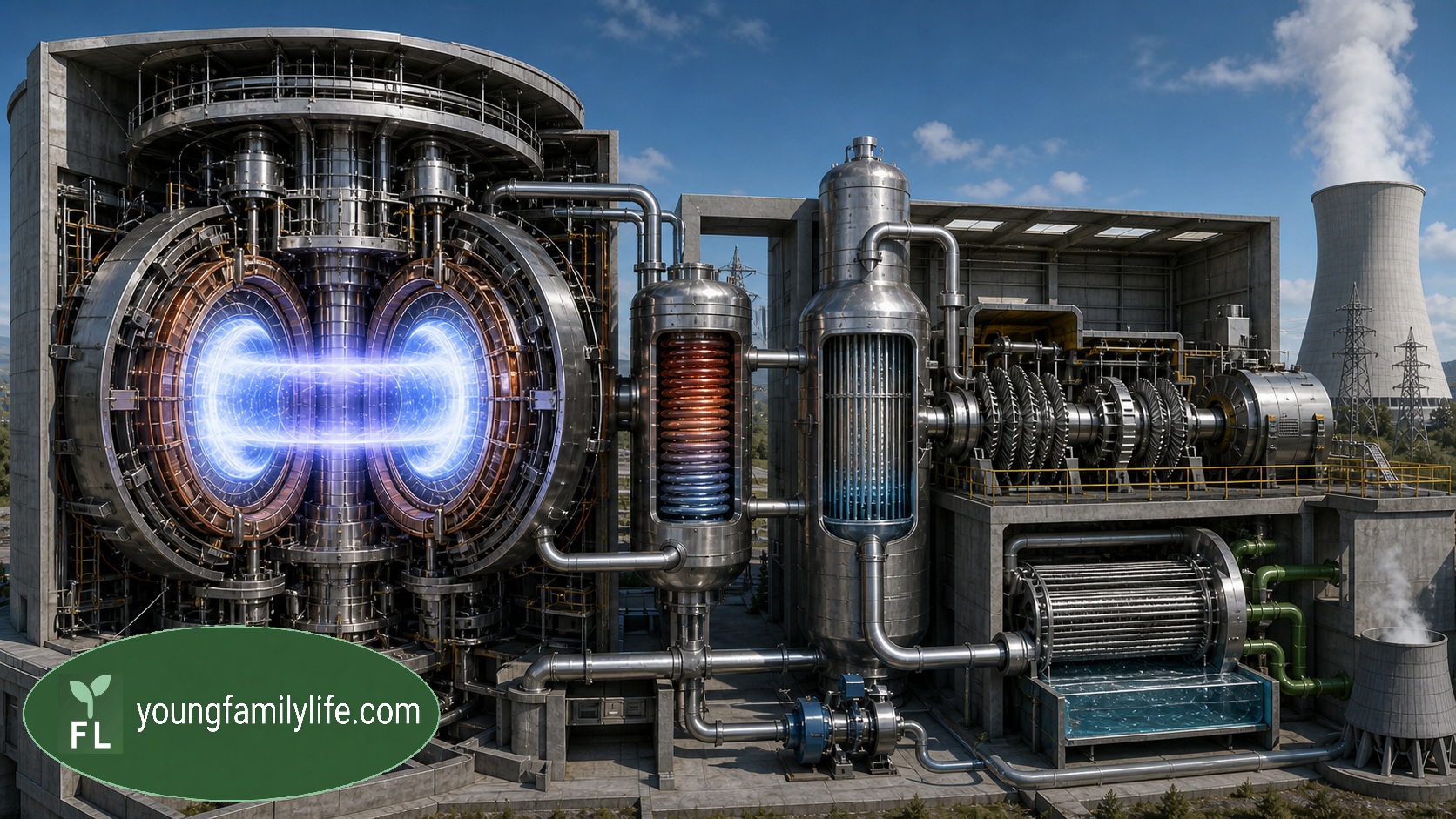
The solution that magnetic confinement fusion uses is to contain the plasma using magnetic fields rather than physical walls. A powerful arrangement of magnets creates a field that holds the plasma suspended — not touching the reactor — in a ring shape inside a doughnut-shaped chamber called a tokamak. The plasma circulates within the magnetic field, sustaining the fusion reaction, while the energy it releases heats a surrounding material and ultimately generates electricity.
The safety characteristic that follows from this is important: fusion reactors cannot melt down. A nuclear fission reactor, if cooling systems fail, continues generating heat from radioactive decay in the fuel — which is what caused the Chernobyl and Fukushima accidents. A fusion reactor that loses its magnetic containment simply stops. The plasma disperses, the fusion reaction ceases, and the reactor cools. There is no runaway condition. The reaction requires continuous active maintenance of the magnetic field to continue at all.
What fusion produces — and what it does not
The primary product of the deuterium-tritium fusion reaction is helium — an inert, non-toxic gas. This is the substance that makes party balloons float. It is not radioactive. It is not dangerous. It disperses harmlessly into the atmosphere.
The fusion process does produce some radioactive material — the neutrons released during fusion activate the surrounding reactor structure, making some components radioactive over time. This is a genuine waste management consideration, but it is categorically different from fission waste. The radioactive materials produced by fusion activation decay to safe levels within decades, not millennia. They can be managed within conventional industrial timescales rather than requiring security across geological ones.
The fuel inputs are also categorically different from fission. Deuterium — one of the two hydrogen isotopes used — can be extracted from seawater. Ordinary seawater. The deuterium in one litre of seawater contains the fusion energy equivalent of approximately 300 litres of petrol. The oceans contain enough deuterium to supply human energy needs for billions of years at current consumption levels. This is the aspect of fusion that can seem implausible to anyone familiar with the scarcity and geopolitical complexity of conventional energy supply — the fuel is in the sea, available to any country with the technology to use it.
Tritium, the second fuel, is rarer — it does not occur naturally in significant quantities but can be produced within the fusion reactor itself using lithium, which is also widely available.
Free fuel — but is it free energy?
The description of fusion fuel as effectively inexhaustible raises a natural question: if the fuel costs almost nothing and is available everywhere, does fusion eventually produce something close to free energy? It is worth answering plainly, because the honest answer is closer to yes than for any other energy source humanity has ever had access to — while still being more complicated than the question implies.
What fusion does not make free is the infrastructure required to trigger and capture the reaction. The tokamak, the superconducting magnets, the systems that breed tritium within the reactor, the heat exchangers, the turbines, the grid connection — all of that requires substantial capital investment, specialist materials, skilled engineering, and ongoing maintenance. Those costs are real and do not disappear because the fuel is cheap.
The more useful way to think about it is through the comparison with solar energy. Solar is also, in a meaningful sense, free at source — photons arrive without invoice. The cost of solar electricity is entirely the cost of the infrastructure to capture it. That cost fell by approximately 90% between 2010 and 2020 as manufacturing scaled and experience accumulated. Solar is now the cheapest source of new electricity generation in history — not because sunlight became cheaper, but because the infrastructure to capture it became cheaper.
Fusion's infrastructure is considerably more complex than solar panels, so the cost floor is higher and the learning curve slower. But the underlying dynamic is the same. Once the capital is deployed, the marginal cost of the fuel input is negligible. The long-run cost of fusion electricity is therefore dominated by capital amortisation and maintenance — not fuel. As more reactors are built and manufacturing experience accumulates, that capital cost per unit of electricity falls. The direction of travel, over time, is toward an energy source whose running cost is lower than anything else available.
There is also a more technical version of the question: whether the total energy budget of the fusion programme — research, construction, and operation across a reactor's lifetime — eventually returns more energy than it consumed. This is measured as a Q factor: energy produced divided by energy required to sustain the plasma. The 2022 NIF experiment was significant because it was the first time any fusion experiment returned more energy from the reaction than was delivered to the fuel. Commercial reactors will need a Q factor substantially higher than 1 to be economically viable. SPARC, the MIT spinout's prototype, is designed for approximately Q=2. A commercial plant would need to exceed that considerably.
Over a reactor's operational lifetime, the energy returned is expected to substantially exceed the energy invested in building and running it. That is the point at which the close-to-free quality of the fuel becomes economically real. It does not happen at first generation. It becomes increasingly true as the technology matures, capital costs fall, and the infrastructure debt of building the first plants is progressively recovered.
So: not free, and not immediate. But the long-run trajectory is toward an energy source whose marginal cost approaches zero in a way that no fossil fuel, and no other renewable, can replicate — because the fuel is genuinely inexhaustible and the act of obtaining it costs almost nothing. That is a different category of energy economics from anything currently operating at scale.
Where fusion stands in relation to fission
Fission is the nuclear technology of the twentieth century. It is operational, widespread, and generating electricity in 32 countries. Its limitations — waste, cost, construction time, public perception — are real and have constrained its expansion. It is nevertheless a significant source of low-carbon electricity and is likely to remain so for decades.
Fusion is the nuclear technology that the twenty-first century is attempting to build. The physics have been confirmed. The engineering challenges are being addressed by 53 private companies that had raised approximately $9.77 billion by mid-2025, alongside major international research programmes. The first commercial fusion electricity reaching a grid is most plausibly a decade or more away. The cost at which it will be commercially available beyond the first-generation plants is not yet modelled.
One of the most significant contributions to fusion's engineering progress came from a source that was not trying to advance fusion at all. The Large Hadron Collider at CERN — the particle accelerator that confirmed the existence of the Higgs boson in 2012 — requires superconducting magnets generating fields of extraordinary strength to steer particles around its 27-kilometre ring. Decades of developing, manufacturing, and operating those magnets produced materials science advances and engineering experience in high-temperature superconductivity that turns out to be precisely what fusion tokamak design needs. The magnets that will contain plasma in commercial fusion reactors owe a substantial debt to technology developed for an experiment that was asking a completely different question about the nature of matter.
In September 2025, CERN and Fusion for Energy — the EU organisation managing Europe's contribution to ITER — signed a formal collaboration agreement specifically citing their shared interest in high-temperature superconducting magnet technologies. CERN was not trying to solve the energy problem when it built the LHC. It was following a scientific question wherever that question led. The technology it developed in doing so turned out to matter enormously for a completely separate application.
This pattern runs through the history of science. Military radar research in the 1940s produced the microwave oven. The internet was developed for defence communications. The World Wide Web was invented at CERN itself, as a tool for sharing particle physics data. Fundamental research conducted without a fixed commercial destination generates enabling technologies whose significance only becomes apparent when a separate field reaches the point of needing them. The follow-your-nose quality of genuine scientific enquiry — pursuing questions for their own sake, without managing the outcome — produces discoveries that directed, commercially targeted research frequently does not. The superconducting magnet technology that may eventually make fusion commercially viable is, in substantial part, a byproduct of asking questions about the structure of matter that had no obvious practical application at the time they were first asked.
The distinction between the two is not that fission is dangerous and fusion is safe — both require careful engineering and management. The distinction is that fission's limitations are inherent to its process: it uses large, unstable atoms that produce long-lived waste and carry meltdown risk. Fusion's limitations are inherent to its engineering challenge: maintaining plasma at extreme temperatures without physical contact. Once that engineering challenge is resolved at commercial scale, the process itself leaves behind no long-lived waste, uses fuel that is effectively inexhaustible, and cannot produce a runaway accident.
What the physics leaves us with
Fission and fusion share a name — nuclear — and draw on the same underlying physics. Beyond that, they are different processes with different fuels, different waste profiles, different safety characteristics, and different timescales for availability.
Fission is the technology that built public associations with nuclear power: complex, expensive, slow, and carrying a waste legacy that requires management across timescales longer than human civilisation has so far existed. Those associations are not inaccurate for fission. They do not transfer to fusion.
Fusion draws its energy from hydrogen isotopes available in seawater, produces no long-lived radioactive waste, cannot melt down, and — if the engineering challenge of magnetic confinement at commercial scale is solved — would provide electricity from a fuel source that is, in any practical sense, inexhaustible. The Mary Poppins quality of that description — energy appearing from an apparently bottomless source, with no toxic residue left behind — is not science fiction. It is an accurate plain description of what the physics produces.
What remains is the engineering. That is a significant caveat. But it is a different kind of caveat from the ones that limit fission. Fission's limitations are in its nature. Fusion's limitations are in the difficulty of building what the physics already supports. And if that difficulty is resolved, the consequences reach considerably further than the electricity market.
One immediate consequence — food and land
The companion essay The Land That Heals Itself and its IOW companion Why the Energy Crisis Is Also a Food and Land Problem both argue that the electricity cost problem is the principal obstacle to controlled environment agriculture becoming economically viable at scale — and therefore to the possibility of moving significant volumes of food production off land, reducing the pressure on British land husbandry that has driven 80 years of intensification.
The energy source that would most directly resolve that obstacle — consistent, dispatchable, low-carbon electricity at a cost that does not make underground and vertical growing financially unsustainable — is not currently available from renewables at the reliability required, or from fission at the cost required. Magnetic confinement fusion, if it reaches commercial scale and follows a learning-curve cost reduction trajectory, could provide it.
That is a conditional with a long timescale attached. It is not a near-term solution. It is a structural possibility within the timescale that ecological land recovery already requires. Whether it arrives within that window, and at what cost, is the open question the companion pieces carry. But the food and land consequence is, in the wider picture, among the more contained of what fusion's success would set in motion.
A speculative coda: who holds the technology holds the leverage
Everything in the preceding sections describes fusion in terms of its physics, its engineering challenge, and its potential as an energy source. What it does not address is the question that follows logically from the fuel-is-free argument: if the fuel cannot be monopolised but the technology can, then whoever controls the reactor technology, the intellectual property, the manufacturing supply chains, and the tritium breeding infrastructure controls the energy supply of everyone who depends on their grid.
This is not a hypothetical concern. It is the structural consequence of any energy transition in which a single technology becomes dominant. Fossil fuels, for all their destructive consequences, have the characteristic of being geographically distributed — multiple producing nations, multiple supply routes, multiple competing interests. The result is a complex, contested, multipolar energy politics. A world running predominantly on fusion could be a world in which a small number of technology companies or state actors hold leverage over the energy supply of billions of people who have no alternative.
The pharmaceutical parallel is instructive. The active compound in a medicine may be a molecule found in nature, or synthesised from widely available materials. The patent on the process is worth everything. Deuterium from seawater cannot be owned. The reactor that converts it to electricity can be — through intellectual property, through manufacturing complexity that only a handful of facilities in the world can achieve, through the control of specialist component supply chains. The fuel being free does not mean the energy is free of leverage.
The counter-argument is also structural. Fission technology has been tightly controlled — the Non-Proliferation Treaty, export controls, state oversight — precisely because it carries weapons applications. Fusion does not have the same weapons pathway, which removes the primary political justification for the monopoly architecture that surrounds fission. Whether that produces a more open technology landscape, or simply a different set of concentrated interests, is genuinely unknown. The solar panel trajectory offers some basis for optimism: first-generation solar was dominated by a small number of manufacturers; it is now produced competitively across dozens of countries. Whether fusion's manufacturing complexity allows the same diffusion, or whether it remains more like aerospace — a sector that has never democratised in the way electronics has — is one of the more consequential open questions the technology carries with it.
What is not in question is the geopolitical disruption that successful fusion would produce. Fusion does not merely change the electricity market. It restructures who holds power. The strategic position of every petrostate — every economy whose leverage in global affairs rests on the fact that others need what lies beneath its territory — is built on energy dependency. If that dependency dissolves, so does the leverage. Russia, the Gulf states, Saudi Arabia, Norway, Iran, Venezuela: the energy export model that underwrites their geopolitical weight evaporates. This is not a peripheral consequence of fusion succeeding. It may be the central geopolitical event of the century if it does.
The space dimension — and the human absence argument
There is a further consequence of fusion succeeding that the energy and geopolitics framing does not reach: what it means for humanity's presence beyond Earth.
The binding constraint on serious extraterrestrial activity has always been energy. Lifting mass from Earth's surface into orbit requires overcoming gravity at a cost that makes almost everything in space extraordinarily expensive. Sustaining human life in space — pressure, temperature, radiation shielding, food, water, atmosphere — requires energy continuously. Deep space travel, at the distances involved in reaching Mars, requires propulsion systems with energy densities that chemical rockets cannot approach. Fusion changes all of this. The energy density available from a fusion reactor, and the propulsion possibilities it opens for spacecraft, make the energy economics of serious space activity substantially more tractable than they are today.
But the more interesting question is not whether fusion enables humans to go to space. It is whether the future of extraterrestrial activity is predominantly human at all.
The economics of keeping humans alive in space are severe. A human being requires constant life support: pressure, warmth, breathable atmosphere, radiation protection, food, water, medical capacity, and a return journey. The cost of providing all of that, at current technology, dwarfs the cost of sending autonomous systems to perform the same function. Drones do not need life support. Robotic systems do not get radiation sickness, do not experience psychological deterioration in isolation, do not require return journeys, and do not die if a seal fails. AI-directed autonomous construction systems can work continuously, in vacuum, at temperatures and radiation levels that would kill a human within hours.
The speculation that follows from this is that the most plausible trajectory for extraterrestrial construction — of stations, of resource extraction infrastructure, of surface habitats eventually intended for human use — is one in which autonomous systems, directed by AI and powered by locally generated energy, perform the majority of the work. Human presence in space, on this trajectory, remains limited to specific high-value functions: scientific judgement, diplomatic presence, activities that genuinely require embodied human decision-making in situ. The construction phase, the infrastructure phase, the resource extraction phase — these are drone and AI territory.
The Moon is the most immediate case. It has no atmosphere, no ecology, no biosphere, no living systems of any kind. The ethical constraints that make resource extraction on Earth a matter of ecological consequence — the damage to soil, water, atmosphere, species, and landscape that every mine and quarry and industrial operation produces — simply do not apply on the lunar surface. There is nothing alive to damage. The Moon's regolith contains helium-3, rare earth elements, and other materials of industrial value. Autonomous systems, powered by fusion reactors assembled on the lunar surface from components launched from Earth and subsequently manufactured locally, could in principle operate extraction infrastructure with minimal ongoing Earth support.
This is not without complication. An emerging body of thought around lunar heritage raises questions about the preservation of sites that carry human historical significance — the Apollo landing sites in particular, which represent the only locations beyond Earth where human beings have physically stood. Whether the Moon's lack of ecological fragility means it carries no obligations of care is a question that has not been settled, and probably should not be assumed settled before extraction begins at scale.
Mars adds a further layer of complexity. The question of whether Mars harbours microbial life — or harboured it — remains genuinely open. If it does, or did, the ethical calculus of industrial activity on its surface is categorically different from the lunar case. The precautionary logic that applies to ecosystems on Earth would apply, with equal force, to the possibility of a Martian biosphere. Autonomous systems are no less capable of causing irreversible damage than human ones; the absence of humans on the surface does not resolve the ethical question, it simply removes the immediacy of human cost from the calculation.
What the space dimension adds to the fusion argument is a further order of consequence. If fusion enables autonomous extraterrestrial resource extraction at scale, the accessible resource base available to human civilisation expands by an order of magnitude that is difficult to conceptualise from within the constraints of a single planet. The Moon alone contains material reserves that dwarf anything accessible through Earth-surface mining. Whether that expansion represents the largest single increase in humanity's resource base since the beginning of industrial civilisation, or simply a transfer of the same extractive logic to a location where its consequences are less immediately visible, is a question the technology trajectory will eventually force into the open.
Fusion, if it works, does not merely change how electricity is generated. It changes the scope of what humanity can do, where it can do it, and who holds the leverage over those possibilities. The physics is the starting point. The consequences extend considerably further.
Topics: #InOtherWords #NuclearFusion #NuclearFission #FusionEnergy #CleanEnergy #EnergyExplained #MagneticConfinement #SpaceExploration #AutonomousSystems #LunarResources #GeopoliticsOfEnergy #FutureOfEnergy #NaturalHealing #YoungFamilyLife
Related YFL Content
In Other Words: Why the Energy Crisis Is Also a Food and Land Problem — The piece this one was written to support: why controlled environment agriculture keeps failing commercially, and what a resolved energy constraint would change for British land.
In Other Words: The Market Problem — The market structure argument that sits alongside the energy argument: why farming differently is economically irrational for most producers in most markets.
In Other Words: The African Grain Story — A parallel case of natural capacity displaced by an intervention that outlasted its original purpose — and the conditions that would have been required to prevent it.
Natural Healing: Understanding Recovery Across Physical, Psychological, and Therapeutic Domains — The framework essay that ties the series together: the broken bone as an entry point to understanding what recovery requires across physical, psychological, and — in this series — ecological contexts.
Copyright Notice
© 2026 Steve Young and YoungFamilyLife Ltd. All rights reserved.
"In Other Words" is a copyrighted content format of YoungFamilyLife Ltd.
The information in this piece is based on established research and theory. Full academic sources, references, and evidential detail are available in the linked YoungFamilyLife essays.
This essay was developed collaboratively using AI assistance to research academic sources and refine content structure, while maintaining the author's original voice, insights, and "Information Without Instruction" philosophy. No part of this essay may be reproduced, distributed, or transmitted in any form or by any means, including photocopying, recording, or other electronic or mechanical methods, without the prior written permission of the copyright holders, except in the case of brief quotations embodied in critical reviews and certain other noncommercial uses permitted by copyright law.
For permission requests, contact: info@youngfamilylife.com