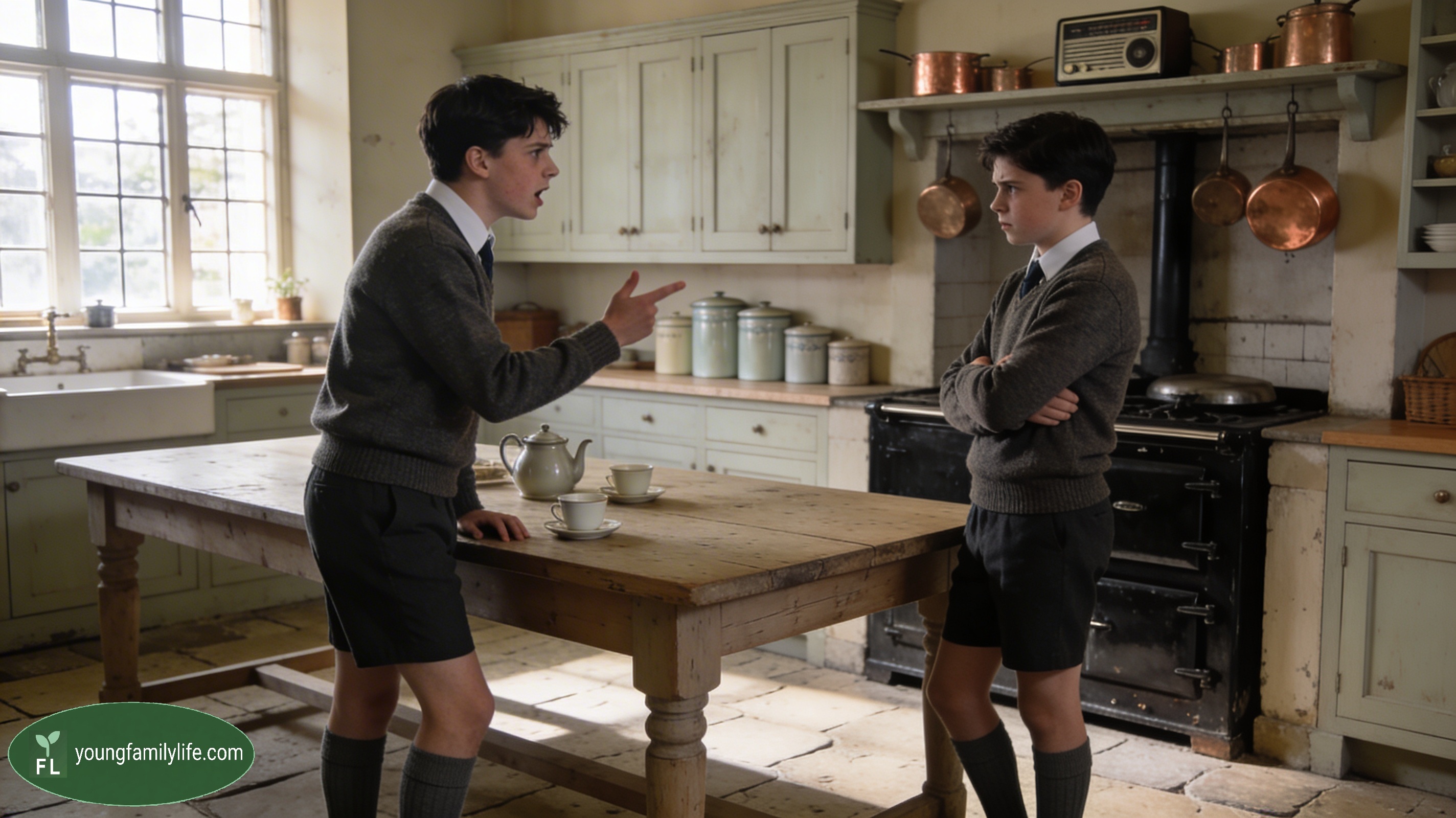
Two brothers, one starting point
Christopher and Peter Hitchens grew up in the same house, went to similar schools, and were shaped by the same world — their father's Royal Navy career, Portsmouth in the 1950s, post-war Britain finding its feet. Both became journalists. Both became well-known voices in public life. And on almost every big question — politics, religion, patriotism, tradition — they ended up on completely opposite sides.
That is more than an interesting family story. Research into how brothers and sisters develop suggests that two children from the same home ending up with very different ways of seeing the world is not unusual at all. The family itself is often a big part of why it happens.
Why brothers and sisters often go in opposite directions
Growing up with siblings means sharing — space, parents' time, attention. Studies of sibling behaviour, including work by psychologist Frank Sulloway, find that children in the same family tend to find their own way to stand out. They settle into separate roles, separate ways of being noticed, separate ways of fitting in.
Christopher, the older by two years, became the rebel — the one who questioned everything while still doing well at school. Peter, coming after him with that ground already taken, found his own equally strong but often opposite positions. Both of them spent their whole adult lives doing essentially the same thing — holding their own views firmly, defending them publicly, refusing to back down — just on a far bigger stage.
The role children find in a family does not tend to disappear when they grow up. It usually just moves somewhere larger.
Same beginning, very different endings
Both brothers started out in roughly the same place politically — both were involved in left-wing student politics in the 1960s and 70s. Then their paths split sharply and kept going in opposite directions.
Christopher moved to America, became an American citizen, and built his name defending science, reason, and a view of the world that did not need religion. He liked challenging whatever the accepted view was, from whichever direction it came. He pushed against things.
Peter came home to England, returned to the Christian faith he had grown up with, and became a strong voice for tradition — for things he felt were being quietly lost. Where Christopher disrupted, Peter defended.
Despite all that, both brothers said roughly the same thing when asked what drove them: they would rather be right than liked. Peter wrote that on this, at least, he and his brother agreed — that saying what you actually believe, even when it makes people uncomfortable, is worth something. Opposite views, same stubbornness about holding them honestly.
A family secret that changed how they saw themselves
Both brothers discovered as adults that their mother had kept her Jewish ancestry hidden for decades — she had done this because of the anti-Semitism of her time. Finding out that a part of their own background had been concealed affected them both, though in different ways. Christopher took it as part of a wider sense of belonging to the world rather than to one particular place. Peter found in it a deeper feeling for how fragile a sense of belonging can be, and how easily things that matter are lost.
Research on how people form their sense of who they are suggests that finding out something important about their own family that had been kept from them can shift the way adults understand themselves. For both Hitchens brothers, the discovery seems to have pushed them further in the direction they were already going.
The same patterns show up at work
The kind of role a person settles into as a child tends to travel with them. Studies of how people behave at work consistently find that the child who always challenged, or the one who always kept the peace, or the one who stood firm whatever happened — those habits show up later in meetings, in teams, in how people handle being disagreed with.
Someone who learned early that pushing back was risky will behave differently under pressure from someone whose place in the family came from never backing down. Neither pattern is simply good or bad. But knowing where it comes from can make it easier to see when it is helping and when it is getting in the way.
The Hitchens brothers also show something else: that strong disagreement and personal respect can go together. Despite arguing publicly and fundamentally for most of their adult lives, they recognised that the other was being honest — that neither was just trying to win. Disagreement without contempt. It turns out to be rarer than it should be.
What this amounts to
The family is not just the place where children are looked after. It is the place where they work out what kind of person they are going to be — what they will stand up for, how much they need others to agree with them, whether being challenged feels like a threat or just a difference of opinion. Those things do not stay behind when children grow up. They travel forward.
Adults who notice a pattern in themselves — the pull to challenge, or to hold things steady; the ease with conflict, or the discomfort with it — have more information about where that came from than they might expect. What they do with it is their own.
Topics: #InOtherWords #SiblingDynamics #FamilyDynamics #IdentityFormation #IntellectualIndependence #LeadershipDevelopment #AttachmentTheory #ProfessionalGrowth #WorkplaceBehaviour #YoungFamilyLife
Related YFL Content
When the Cat Rules the Dog: Psychology of Confidence in Social Groups — explores how quiet confidence operates in group settings, connecting naturally to the Hitchens brothers' capacity to hold unpopular positions with composure.
Hey!, Want To Know: Why Do Household Rules Matter? — one of six Family Climate HWTK pieces exploring the building blocks of a family's emotional environment.
Hey!, Want To Know: Why Emotional Warmth Matters to a Child — on how warmth within a family shapes how children experience safety and belonging.
Hey!, Want To Know: Why Some People Are Genuinely Easy Going — on the attachment patterns behind people who seem to go along with everything.
Hey!, Want To Know: Why Some People Can See What Has Been Missed — on the pattern behind people who challenge, push back, and notice what others overlook.
Hey!, Want To Know: Why Some People Can Be Relied on Left to Get Things Sorted — on the attachment pattern behind people who quietly get on with it regardless of what is happening around them.
Copyright Notice
© 2026 Steve Young and YoungFamilyLife Ltd. All rights reserved.
"In Other Words" is a copyrighted content format of YoungFamilyLife Ltd.
The information in this piece is based on established research and theory. Full academic sources, references, and evidential detail are available in the linked YoungFamilyLife essays.
This essay was developed collaboratively using AI assistance to research academic sources and refine content structure, while maintaining the author's original voice, insights, and "Information Without Instruction" philosophy. No part of this essay may be reproduced, distributed, or transmitted in any form or by any means, including photocopying, recording, or other electronic or mechanical methods, without the prior written permission of the copyright holders, except in the case of brief quotations embodied in critical reviews and certain other noncommercial uses permitted by copyright law.
For permission requests, contact: info@youngfamilylife.com