The thinker most families have never heard of
Roberto Assagioli is not a household name. His two contemporaries — Freud and Jung — became cultural figures, their ideas absorbed into the general vocabulary of the modern world. Assagioli, working in Florence across a life that spanned most of the twentieth century, remained less visible — partly by temperament, partly by geography, and partly because his ideas resist the kind of dramatic simplification that generates fame.
What he was proposing, however, was something that matters enormously for families: that the human being is not primarily a system to be repaired, a conflict to be resolved, or a shadow to be integrated. The human being is a self in motion toward something. And that something — joy, meaning, the gradual realisation of what the person is genuinely capable of — is not a reward for getting everything else right. It is a psychological necessity. Its absence has consequences as real as any pathology.
This proposition — that the upward direction of human development matters as much as the downward one — is Assagioli's central contribution. It is, in the early twenty-first century, more influential than it has ever been, even when the name behind it goes unrecognised.
The map of the interior life
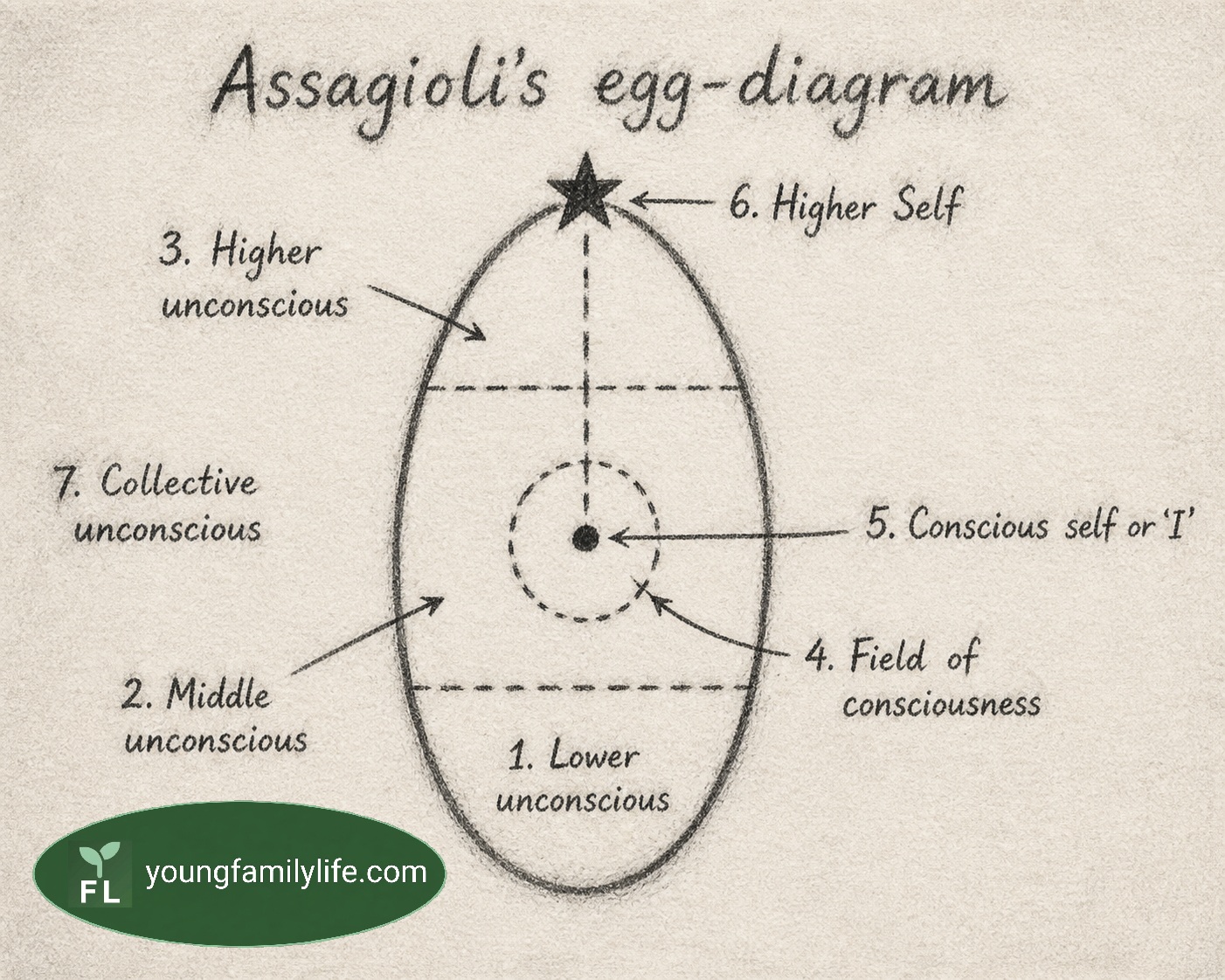
Assagioli's most original theoretical contribution is his model of the psyche — usually represented as an oval or egg shape — which gives a fuller picture of the human interior than either Freud or Jung provided.
The lower part of the egg contains what Freud mapped: the lower unconscious, where repressed memories, unresolved conflicts, instinctual energies, and the accumulated residue of old experience reside. This material is not static. It is in motion — exerting upward pressure on conscious life, and capable of surging into awareness when disturbed by events that echo its contents. The parent who finds themselves unexpectedly overwhelmed by a child's distress, or the young person whose anxiety spikes without apparent cause, may be responding to something stirred in these depths.
The middle of the egg is the territory of ordinary conscious functioning — the thoughts, feelings, and preoccupations accessible with normal reflection.
What makes Assagioli's model distinctive is the upper portion of the egg: the higher unconscious, or superconscious. This is not a spiritual claim — Assagioli was careful to maintain a psychological framework — but a structural one. The superconscious is the region from which inspiration, creativity, ethical intuition, and the experience of genuine meaning arise. It is the source of what Assagioli called the higher qualities of human experience: the things that make life feel worth living, as distinct from merely manageable.
At the centre of the egg sits the personal self — the observing "I" that can notice thoughts, feelings, and impulses without being wholly identified with them. Above and beyond it is the Higher Self: the deeper integrating centre that connects the individual to something larger than their personal history.
For families, this map does something neither Freud's nor Jung's model fully achieves: it locates, within the same framework, both the depths that press upward and the heights that pull forward. It makes the full range of human experience — from the most primitive anxiety to the most expansive aspiration — part of a single, coherent picture.
The multiple selves within the one person
One of Assagioli's most practically useful ideas is the concept of subpersonalities — the relatively autonomous psychological configurations that coexist within a single person. Each has its own characteristic emotional tone, its own logic, its own way of relating. The careful, competent professional and the frightened child; the warm and generous friend and the cold, withdrawing self that appears under certain kinds of pressure; the patient parent and the one who, in a particular moment of stress, becomes someone neither they nor the child recognises — these are not contradictions requiring explanation. They are subpersonalities, and their presence is a normal feature of psychological life.
The problem is not having them. The problem is not knowing they are there. A person who is identified with a subpersonality — who in a given moment is the frightened child, or the controlling authority, or the helpless bystander — has temporarily lost access to the observing "I" that could recognise what is happening and choose a different response. They are not making a decision. They are being run.
Families are full of this. The parent who said something they do not, on reflection, believe. The child who behaved in a way that genuinely surprised them. The couple who re-entered an argument they have had a hundred times, following a script neither wrote and neither endorses. In each case, a subpersonality has come to the surface — often in response to something that triggered material from the lower unconscious — and the observing self temporarily disappeared.
Recognising this does not prevent it from happening. But it changes what it means when it does. And it opens the possibility of working with these configurations rather than being governed by them.
Joy as a direction, not a destination
The idea that may be Assagioli's most important, and most underappreciated, is his insistence that joy is not the reward for resolving everything else — it is a psychological need with the same standing as safety, or belonging, or understood experience.
The will toward synthesis — Assagioli's term for the human drive toward integration, toward meaning, toward the expression of one's deeper nature — is the engine of psychological development. Joy is its signal. A person who is moving in the right direction, even through difficult terrain, tends to feel something that is recognisable as aliveness. A person who has successfully managed their symptoms and resolved their conflicts but has no direction — the competent, functioning, entirely empty adult — does not.
This matters for families because adults pass on what they embody, not what they instruct. A parent who is genuinely oriented toward something — who has a direction, a sense of what they are living for, a capacity for joy that is not conditional on everything going well — communicates this to the children around them in ways that precede and exceed any deliberate teaching. Children are extraordinarily sensitive to whether the adult in front of them is alive or performing. They read it in the ordinary moments: the walk to school, the meal at the table, the goodnight said in the dark.
A parent who tells a child to be good, to grow up, to pull themselves together — whilst modelling a life organised entirely around avoiding what is difficult — is transmitting something the words cannot undo. What children absorb from the adults closest to them is not primarily the content of what those adults say. It is the quality of the life those adults are living.
What Psychosynthesis cannot promise
Assagioli's framework carries a risk that he himself acknowledged, and that honesty requires naming. Joy as a psychological direction can become, in the wrong hands, a new kind of pressure — another thing the person is failing to achieve, another standard against which they fall short. The will toward synthesis, if it is imposed rather than cultivated, produces not flourishing but another variety of performance.
Assagioli was clear that joy cannot be instructed. It can only be permitted — created the conditions for. The role of the adult, whether parent or practitioner, is not to point the young person toward joy and say: go there. It is to remove, where possible, the obstructions that prevent them from finding it themselves. That is a more modest, more patient, and ultimately more respectful proposition than any prescriptive model of growth.
The families who hold Assagioli's ideas most usefully are not the ones who use them to set higher standards for themselves or their children. They are the ones who use them to ask a quieter question: what might this person need in order to become more fully themselves? That question has no guaranteed answer. But asking it tends to open something that the demand for immediate compliance cannot reach.
Topics: #InOtherWords #Assagioli #Psychosynthesis #Subpersonalities #Joy #FamilyLife #ParentingResearch #PsychologicalWholeness #YoungFamilyLife #FamilyPsychology
Related YFL Content
In Other Words: Freud's Legacy in Use — the companion IOW piece: the unconscious, defence mechanisms, and the repetition compulsion — what the parent brings into the room without knowing it.
In Other Words: Jung's Legacy in Use — the second piece in the suite: the shadow, individuation, and why difficulty in families is often signal rather than failure.
Freud, Jung, and Assagioli — A Public Debate — all three in direct argument: the motion "Today's young people should grow up, pull themselves together and be good," chaired by Claude.
Natural Healing — the psyche's capacity for self-repair: the dimension of Assagioli's framework that neither Freud nor Jung fully addressed, examined across physical, psychological, and relational recovery.
Copyright Notice
© 2026 Steve Young and YoungFamilyLife Ltd. All rights reserved.
"In Other Words" is a copyrighted content format of YoungFamilyLife Ltd.
The information in this piece is based on established research and theory. Full academic sources, references, and evidential detail are available in the linked YoungFamilyLife essays.
This essay was developed collaboratively using AI assistance to research academic sources and refine content structure, while maintaining the author's original voice, insights, and "Information Without Instruction" philosophy. No part of this essay may be reproduced, distributed, or transmitted in any form or by any means without the prior written permission of the copyright holders, except in the case of brief quotations embodied in critical reviews and certain other noncommercial uses permitted by copyright law.
For permission requests, contact: info@youngfamilylife.com