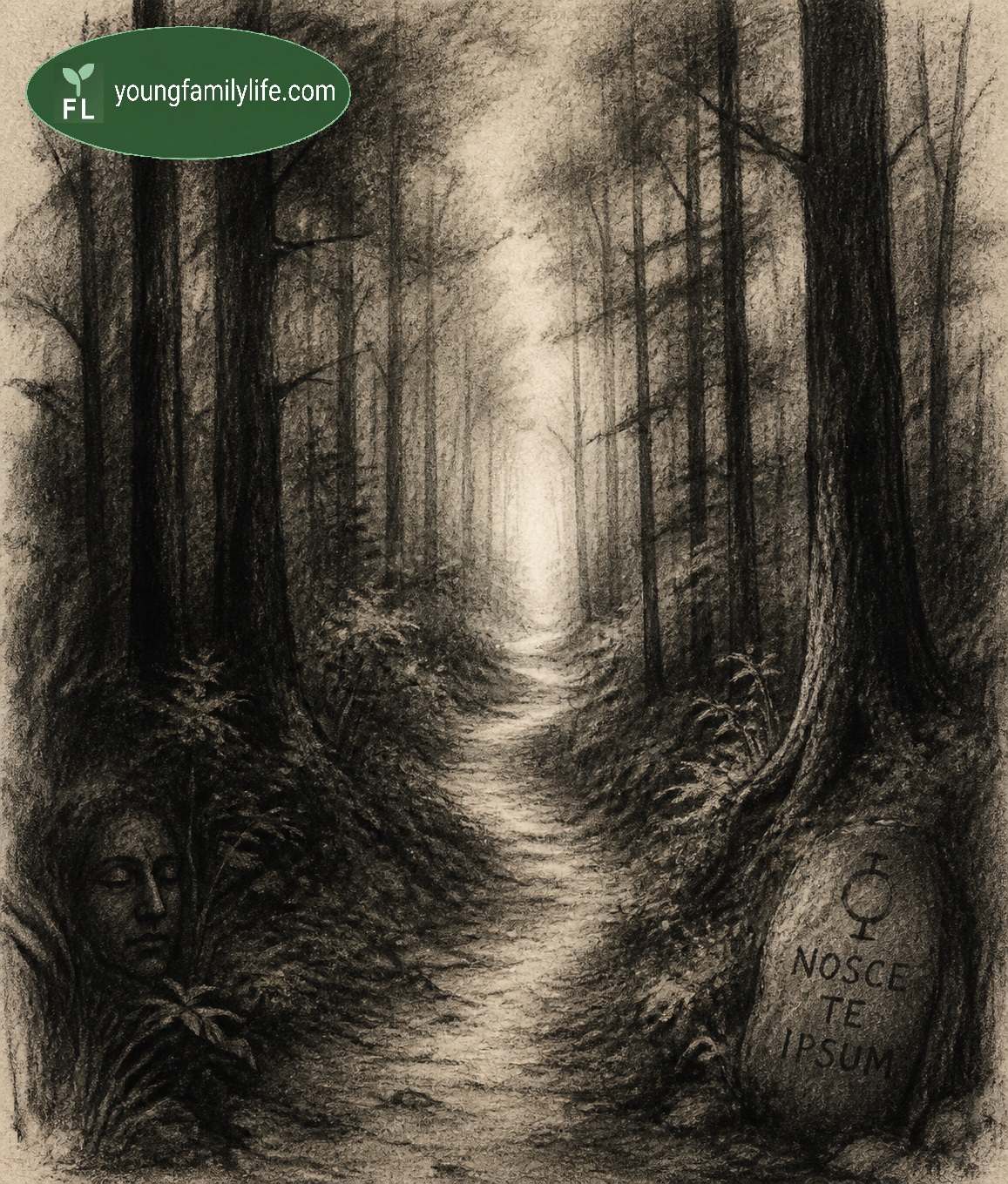
What Jung was actually saying
Carl Gustav Jung is most often encountered in popular culture through his type system — introvert and extravert, the four functions, the personality frameworks derived from his work that now appear in every team-building workshop and online quiz. These are real contributions, but they are not where Jung's most significant ideas live. The typology is, in many respects, the most accessible and the least important part of what he built.
What Jung was fundamentally proposing — across a body of work that ran from clinical psychiatry through mythology, alchemy, Eastern philosophy, and the analysis of his own dream life — was this: that beneath the individual human biography, there are patterns older and larger than any single person. That the human psyche carries, in its depths, a kind of inherited grammar — a set of structural tendencies to produce certain images, fears, and longings, regardless of culture, historical period, or personal history. And that psychological development, properly understood, is not the management of these patterns but their integration — the gradual, difficult, never-fully-completed process of becoming a more whole version of oneself.
For families, the implication is significant. The difficult child, the unreachable teenager, the parent who cannot understand why they keep doing the same thing despite their best intentions — are not, in Jung's account, simply failing. They are in the middle of something. The question is whether the people around them can hold that possibility long enough for something to move.
The thing people carry but cannot see
Jung's most practically useful concept, for those who work with families and those who live in them, is the shadow. The shadow is not a metaphor for evil, though it is often misread that way. It is a precise psychological description of what happens to the parts of a person that are judged unacceptable — by parents, by culture, by the person themselves — and therefore cannot be consciously held.
Every child arrives with a full range of human qualities. In the course of growing up, certain of those qualities are welcomed — praised, rewarded, modelled — and others are not. The anger that gets punished, the vulnerability that earns contempt, the playfulness that is told to grow up, the ambition that is called selfishness: these qualities do not disappear when they are rejected. They go into the shadow — the part of the psyche that is out of sight, unowned, and therefore unmanageable.
The shadow does not stay quietly in the dark. It surfaces. It surfaces in disproportionate reactions — the sudden fury at something that does not seem to warrant it, the unexpected grief, the attraction to something the conscious self is sure it despises. And it surfaces in projection: the tendency to see in other people the qualities one cannot tolerate in oneself. The parent who is most violently critical of a particular behaviour in their child is very often, in Jung's account, in contact with something they have suppressed in themselves. The anger is real. But its real target is not the child.
This is not a comfortable idea. It is, however, an enormously useful one — because it moves the question from correction to curiosity. What is this reaction telling the adult about themselves, rather than about the child?
The process of becoming, and why it cannot be rushed
Individuation is Jung's term for the lifelong process of psychological development — the movement toward becoming, progressively and never finally, a more complete version of oneself. It involves the integration of shadow material, the withdrawal of projections, the dissolution of the mask worn for social purposes, and the gradual alignment of the conscious self with the larger patterns of the psyche.
This is not a smooth or comfortable process. It tends to intensify at particular life transitions — adolescence, midlife, major loss, retirement — when the existing structure of the self becomes inadequate to what life is now asking. At these points, the unconscious presses harder. Dreams become more vivid. Relationships become more charged. Behaviour that was previously contained becomes harder to manage. Jung understood these as signal, not failure — the psyche insisting, with increasing pressure, that something needs to change.
For families, this has particular relevance in how adolescence is understood. The young person who becomes volatile, who withdraws, who apparently dismantles the identity they had carefully constructed in childhood, who becomes the precise opposite of what they seemed to be — is, in Jung's framework, individuating. Something is being shed because it was never really theirs. Something is being encountered in the depths that has never been met before. The adult who pathologises this process, who tries to suppress the disruption and reinstate the previous version of the young person, is working against the psyche's own direction.
That does not mean the disruption is easy to live with. It means the response to it makes a difference.
What wholeness without relationship cannot produce
Jung's work focuses primarily on the interior life — the inner encounter with the shadow, with the archetypes, with the deeper patterns of the psyche. It can give the impression that individuation is fundamentally a solitary process: a descent into one's own depths, an encounter with one's own unconscious, an emergence into a self more authentically one's own.
But wholeness without relationship is not wholeness. It is a more elaborate form of withdrawal. The self becomes more coherent, perhaps — better known to itself, less at the mercy of its own unrecognised patterns — but if that coherence is not tested and developed in contact with other people, it remains incomplete. The relationship — the family, the friendship, the working partnership — is not an interruption to the process of becoming more whole. It is one of its primary mechanisms. The other person mirrors what the individual cannot see. They provoke the projections that most need to be withdrawn. They demand the engagement, the friction, the vulnerability, without which development stalls.
For families, this means that the quality of the relational field matters as much as any individual's inner work. A family that can hold difference without needing to resolve it too quickly — that can remain in contact with one another through the disruptions of individuation, without requiring the disrupting person to return to who they were — creates conditions in which development becomes possible for everyone in it.
What Jung's ideas leave families with
The most useful thing Jung leaves for families is a different way of understanding difficulty. Not as failure, not as pathology, not as a behaviour problem requiring correction — but as signal. The child who is most difficult may be the one in whom something most alive is pressing for recognition. The parent who reacts most strongly may be the one in whom something most unresolved is seeking attention. The family that is most in conflict may be the one in which the most real material is circulating — looking for a container capable of holding it.
None of this makes the difficulty easier to live with in the moment. But it changes what the difficulty is for. And when the difficulty is understood differently, the response to it tends to change — often without any deliberate effort, simply as a consequence of the shift in perception.
Jung's legacy, in the end, is an expansion of what counts as meaningful. The behaviour that seems irrational has a logic. The emotion that seems disproportionate has a source. The person who cannot simply pull themselves together may be in the middle of something important — something that cannot be resolved by instruction, only by time, relationship, and the patience to remain present whilst it moves.
Topics: #InOtherWords #Jung #AnalyticalPsychology #Shadow #Individuation #FamilyLife #ParentingResearch #Archetypes #YoungFamilyLife #FamilyPsychology
Related YFL Content
In Other Words: Freud's Legacy in Use — the companion IOW piece: what psychoanalysis left behind, and how the unconscious continues to shape what happens between parents and children.
In Other Words: Assagioli's Legacy in Use — the third piece in the suite: what Psychosynthesis left behind, and the question of joy as a psychological necessity rather than a reward.
Freud, Jung, and Assagioli — A Public Debate — all three in direct argument: the motion "Today's young people should grow up, pull themselves together and be good," chaired by Claude.
The Borrowed Self — the loss of authentic selfhood that Jung would recognise as identification with the persona: what happens when the need to belong overrides the development of a genuine inner life.
Copyright Notice
© 2026 Steve Young and YoungFamilyLife Ltd. All rights reserved.
"In Other Words" is a copyrighted content format of YoungFamilyLife Ltd.
The information in this piece is based on established research and theory. Full academic sources, references, and evidential detail are available in the linked YoungFamilyLife essays.
This essay was developed collaboratively using AI assistance to research academic sources and refine content structure, while maintaining the author's original voice, insights, and "Information Without Instruction" philosophy. No part of this essay may be reproduced, distributed, or transmitted in any form or by any means without the prior written permission of the copyright holders, except in the case of brief quotations embodied in critical reviews and certain other noncommercial uses permitted by copyright law.
For permission requests, contact: info@youngfamilylife.com