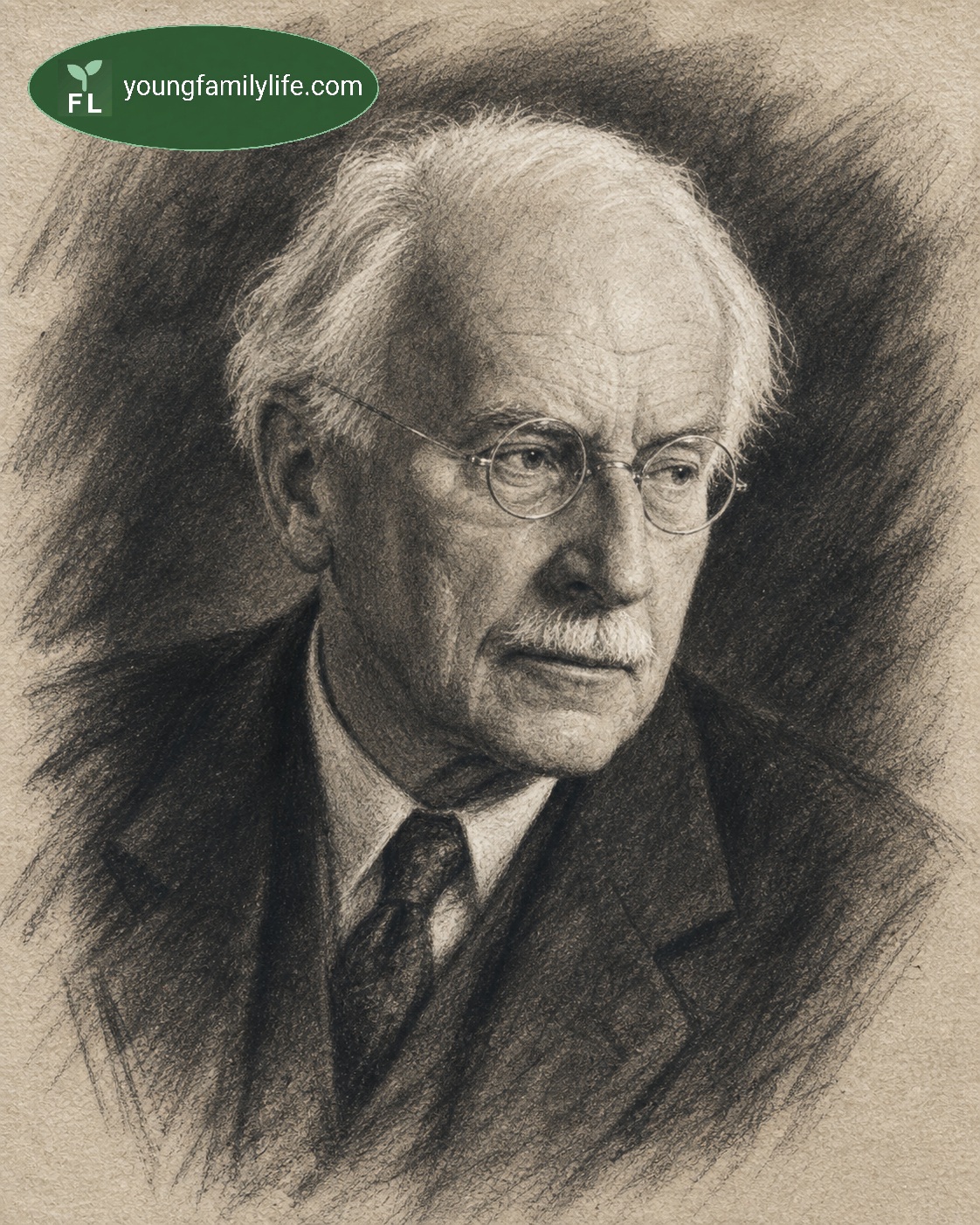
The Life
Carl Gustav Jung was born on 26 July 1875 in Kesswil, a small village on Lake Constance in the Swiss canton of Thurgau. His father, Johann Paul Achilles Jung, was a rural Protestant pastor; his mother, Emilie Preiswerk, came from a family with a strong tradition of spiritualism and claimed visionary experience. The tension between his father's failing faith and his mother's otherworldly leanings shaped Jung profoundly: he grew up in a household where the official religion was observed and the unofficial one — the uncanny, the symbolic, the numinous — was equally present.
He was a solitary and interior child, given to powerful dreams and early experiences that he would later describe as formative encounters with the unconscious. He studied medicine at the University of Basel, graduating in 1900, and then moved to Zürich to work at the Burghölzli psychiatric clinic under Eugen Bleuler — the clinician who coined the term "schizophrenia." It was at the Burghölzli that Jung developed his word association test, an empirical method for detecting unconscious complexes, and began to publish the research that would bring him to the attention of Sigmund Freud.
The meeting of Freud and Jung — first in Vienna in 1907, when they famously talked for thirteen hours without pause — was one of the great intellectual encounters of the twentieth century, and one of its most dramatic ruptures. Freud saw in Jung the ideal successor: younger, not Jewish, well-credentialled, and capable of carrying psychoanalysis beyond the Viennese circle into the wider world. He appointed Jung the first president of the International Psychoanalytic Association in 1910. Jung, for his part, was genuinely moved by Freud's work — but increasingly troubled by what he saw as the reduction of all psychological phenomena to sexual libido and the dogmatic insistence with which this reduction was defended.
The break, which came formally in 1913, was personally devastating to both men and institutionally significant for the entire field. Jung entered a period he later described, in his memoir Memories, Dreams, Reflections, as a creative illness — several years of intense, deliberately induced encounter with the material of his own unconscious. He filled notebooks with dreams, fantasies, and visionary experiences that he called active imagination. The product of this period — documented in the extraordinary illustrated manuscript known as The Red Book, not published until 2009 — was the experiential foundation of analytical psychology.
Jung had married Emma Rauschenbach in 1903; they had five children and remained married until Emma's death in 1955. His long relationship with Toni Wolff — a former patient who became a collaborator, companion, and analytical partner — was conducted with Emma's difficult knowledge and was never fully concealed. It is one of the most debated aspects of his biography, raising questions about the ethics of therapeutic relationships that remain live today.
After the break with Freud, Jung built his practice and his theory in Küsnacht, the lakeside house near Zürich that he designed and extended himself. He travelled widely — to North Africa, to the American Southwest to meet the Pueblo Indians, to East Africa, to India — seeking cross-cultural confirmation of his hypotheses about the universal structures of the unconscious. He read enormously — alchemy, Gnosticism, mythology, Eastern philosophy — finding in these traditions a symbolic language that confirmed and extended his psychological observations.
He continued to write and practise until late in his life, receiving visitors, patients, and disciples from around the world. He died on 6 June 1961 at his home in Küsnacht, at the age of eighty-five.
The Theory
The Personal and Collective Unconscious
Jung accepted and extended Freud's account of the personal unconscious — the repository of repressed memories, complexes, and forgotten experience belonging to the individual. But he proposed, on the basis of his clinical work and his cross-cultural reading, a deeper layer: the collective unconscious. This is not personal but universal — a shared psychic substrate, inherited across generations, containing the accumulated experience of the human species in the form of predispositions to image, pattern, and response.
The collective unconscious is not accessible as memory or experience, but expresses itself through archetypes — primordial patterns that appear, with remarkable consistency, across cultures, mythologies, religions, and the dreams of individuals who have had no contact with each other. The archetypes are not images themselves but the tendency to produce images of a particular kind: the Great Mother, the Hero, the Shadow, the Wise Old Man, the Trickster. They are the structural grammar of the human imagination.
The Archetypes
The Shadow is the archetype of what has been rejected, suppressed, or denied in the development of the conscious personality. Everything the individual cannot accept in themselves — the aggressive impulses, the desires judged unworthy, the qualities that were criticised or shamed in childhood — becomes shadow material. The shadow does not disappear; it persists in the unconscious and projects itself outward onto others. The person who condemns a quality violently in someone else is often most reliably in the grip of that quality themselves.
The Persona is the social mask — the face presented to the world, constructed to meet the expectations of the individual's roles and relationships. The danger is identification with the persona: mistaking the mask for the face, which produces a rigidity and inauthenticity that eventually costs the individual their connection to their own interior life.
The Anima and Animus — the feminine element in the male psyche and the masculine element in the female psyche respectively — represent the inner contrasexual character, which mediates between consciousness and the deeper layers of the unconscious.
The Self — not the ego, but the larger organisational centre of the total psyche — is the archetype of wholeness. It appears in dreams and religious imagery as the mandala, the divine child, the philosopher's stone. The Self is both the goal and the guide of psychological development.
Individuation
Individuation is Jung's central concept: the lifelong process by which the individual moves toward psychological wholeness — the integration of the various elements of the psyche, including shadow material and unconscious contents, around the Self as organising centre. It is not a comfortable process. It requires the encounter with what has been denied, the withdrawal of projections, the dissolution of identifications with the persona, and the gradual recognition that the ego is not the centre of the psyche but one element within a larger whole.
Individuation is not solipsistic: it cannot occur without relationship. The other person serves as mirror and friction — revealing the projections, confronting the shadow, demanding the withdrawal of what has been attributed to the outside world and belongs within.
Psychological Types
Jung's Psychological Types (1921) introduced the concepts of introversion and extraversion — orientations of libidinal energy toward the inner world or the outer world respectively — and four functions of consciousness: thinking, feeling, sensation, and intuition. The combination of attitude and dominant function produces a typology of personality that, in its popular derivatives (most notably the Myers-Briggs Type Indicator), has become one of the most widely used frameworks in organisational psychology and personal development, often in ways Jung would not have recognised or endorsed.
Synchronicity
Late in his career, Jung proposed the concept of synchronicity — meaningful coincidence that cannot be explained by causality but which reveals, he believed, an underlying connection between psychic events and physical events in the external world. This was his most speculative and least empirically defensible proposal, and it drew him into collaboration with the physicist Wolfgang Pauli, who was interested in the parallels between quantum mechanics and Jung's psychological observations.
The Legacy
Jung's influence is broad, deep, and often unacknowledged. The concepts of introversion and extraversion are now part of everyday language. The shadow — the idea that we contain within us what we most condemn in others — has entered both therapeutic practice and cultural analysis with remarkable penetrating power. Depth psychology as a field — the serious study of the unconscious in clinical, creative, and spiritual life — is largely his creation.
His influence on religion and spirituality has been particularly significant. His respectful, empirical engagement with religious experience — as a psychological phenomenon of the first importance, regardless of its metaphysical status — gave intellectual credibility to the interior life at a time when both orthodox religion and scientific materialism were hostile to it. Joseph Campbell's influential work on mythology drew heavily on Jungian archetypes. The transpersonal psychology movement — of which Assagioli was a co-founder — is deeply indebted to Jung's opening of psychology toward questions of meaning, transcendence, and the higher dimensions of human experience.
His critics have pointed to the mystical and sometimes obscurantist quality of his later work; to the unverifiable nature of the collective unconscious as a scientific claim; to his conduct during the Nazi period; and to the ethical problems of his personal life, particularly his relationship with patients. These criticisms are not trivial and should not be minimised. They sit alongside, rather than cancelling, the significance of what he built.
What survives these criticisms is the map. The proposition that beneath the personal biography there are patterns older than any individual. That the things we most fear in ourselves do not go away when we refuse to look at them, but become more powerful. That development is not the absence of struggle but the willingness to be changed by it. That the Self — the whole, integrated person we are in the process of becoming — is not a destination to be reached but a direction to be held. These ideas, in their various cultural transformations, have shaped how the modern world thinks about growth, identity, meaning, and the examined life.
References
Primary Works
Jung, C. G. (1921). Psychological Types. In The Collected Works of C. G. Jung (Vol. 6). Routledge & Kegan Paul.
Jung, C. G. (1934–1954). The Archetypes and the Collective Unconscious. In Collected Works (Vol. 9, Part I). Routledge & Kegan Paul.
Jung, C. G. (1951). Aion: Researches into the Phenomenology of the Self. In Collected Works (Vol. 9, Part II). Routledge & Kegan Paul.
Jung, C. G. (1963). Memories, Dreams, Reflections (A. Jaffé, Ed.; R. and C. Winston, Trans.). Pantheon Books.
Shamdasani, S. (Ed.) (2009). The Red Book: Liber Novus (M. Kyburz, J. Peck, and S. Shamdasani, Trans.). W. W. Norton & Company.
Biography and Scholarship
Bair, D. (2003). Jung: A Biography. Little, Brown and Company.
Ellenberger, H. F. (1970). The Discovery of the Unconscious: The History and Evolution of Dynamic Psychiatry. Basic Books.
McGuire, W. (Ed.) (1974). The Freud/Jung Letters. Princeton University Press.
Storr, A. (1983). Jung: Selected Writings. Fontana Press.
Topics: #Jung #AnalyticalPsychology #Shadow #Individuation #CollectiveUnconscious #Archetypes #Persona #PsychologicalTypes #PsychologicalTheory #FamilyLife #YoungFamilyLife
Copyright Notice
© 2026 Steve Young and YoungFamilyLife Ltd. All rights reserved.
This essay was developed collaboratively using AI assistance to research academic sources and refine content structure, while maintaining the author's original voice, insights, and "Information Without Instruction" philosophy. No part of this essay may be reproduced, distributed, or transmitted in any form or by any means without the prior written permission of the copyright holders, except in the case of brief quotations embodied in critical reviews and certain other noncommercial uses permitted by copyright law.
For permission requests, contact: info@youngfamilylife.com