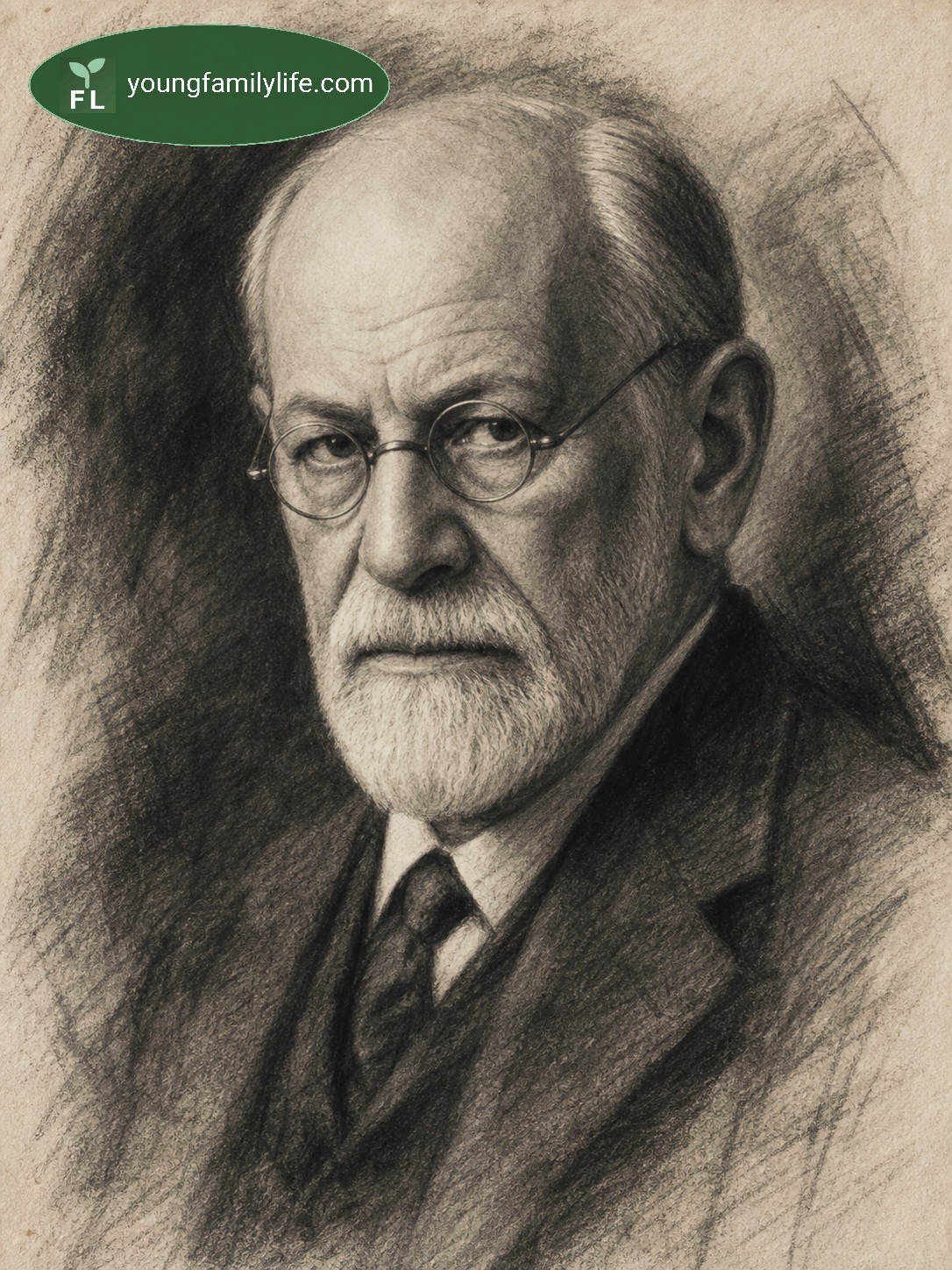
The Life
Sigmund Freud was born on 6 May 1856 in Freiberg, Moravia — now Příbor in the Czech Republic — the eldest son of Jakob Freud, a wool merchant, and his third wife Amalia. When Freud was four, the family moved to Vienna, the city that would define and confine him for the next eight decades. He was a brilliant student, reading Shakespeare in English at eight, entering the University of Vienna at seventeen, and graduating in medicine in 1881 after a period of extended scientific research that included serious work in zoology and neurology under the physiologist Ernst Brücke.
His early career was shaped by financial necessity and intellectual restlessness. He worked as a clinical neurologist, became engaged to Martha Bernays in 1882, and in 1885 travelled to Paris to study under the great neurologist Jean-Martin Charcot, whose theatrical use of hypnosis with hysterical patients planted a seed that would not leave him. Back in Vienna, he entered a formative collaboration with the physician Josef Breuer, whose patient "Anna O." — treated through what Breuer called the "talking cure" — became the founding case of what would eventually be called psychoanalysis.
Freud married Martha in 1886. They had six children: Mathilde, Martin, Oliver, Ernst, Sophie, and Anna. Of these, it was the youngest — Anna, born 1895 — who would become not only the most intellectually significant to Freud personally but a major theorist in her own right. Sophie died in 1920 during the influenza epidemic, a loss that left Freud permanently marked.
The publication of The Interpretation of Dreams in 1900 — which Freud considered his most important work — began the long, slow process of recognition. By the early 1900s a circle of followers had formed around him, meeting weekly at his apartment in the Berggasse: the Wednesday Psychological Society, which became the Vienna Psychoanalytic Society. Among those who joined were Alfred Adler and Carl Gustav Jung — both of whom would eventually depart, bitterly, to found their own schools.
Freud was diagnosed with oral cancer in 1923, almost certainly the consequence of his famous cigar habit, and underwent more than thirty operations over the following sixteen years. He continued to work, write, and theorise through considerable pain. The political catastrophe that had been building across the decade arrived with increasing speed. In 1933, following Hitler's appointment as Chancellor, Freud's books were burned in Berlin — and in Vienna shortly afterwards. The regime that would eventually force him from his home had announced its intentions clearly: his work, and the tradition it represented, had no place in the new order. Freud had anticipated something of this. Civilisation and Its Discontents (1930), written in the years before the worst became visible, had already argued that the suppression of instinct demanded by civilisation carried a psychological cost that civilisation itself was unwilling to acknowledge — and that this cost, unexamined, accumulated. He could feel what was accumulating. When the Nazis annexed Austria in 1938, Freud — already internationally famous — was permitted to leave, largely through the intervention of Princess Marie Bonaparte and Ernest Jones. It was Anna who negotiated with the Gestapo on her father's behalf and organised the family's departure. He arrived in London in June 1938, at the age of eighty-two, and died there on 23 September 1939, less than a month after the outbreak of the Second World War. At his request, a lethal dose of morphine was administered by his physician. Anna was present at his death and outlived him by forty-three years.
Sigmund Freud and Anna Freud
The relationship between Sigmund Freud and his youngest daughter is one of the most complex and ethically contested in the history of psychoanalysis. Anna entered the psychoanalytic world entirely through her father — she was analysed by him between 1918 and 1922, a practice that would now be considered a serious violation of therapeutic boundaries and which was controversial even among Freud's contemporaries. Ernest Jones and others raised objections; Freud dismissed them. He believed he understood his daughter better than anyone else could, and that the analysis was both clinically sound and personally necessary for her development as a practitioner.
Whatever the ethical weight of that decision — and it is considerable — the intellectual relationship between them was genuine and deep. Anna became his closest collaborator in his final years, managing his correspondence, accompanying him to conferences, and acting as his representative when his cancer made public appearances difficult. She was his preferred companion and, in the eyes of many who knew the family, his most beloved child.
She never married. She devoted her life, with extraordinary single-mindedness, to the advancement of psychoanalytic work — first in Vienna, then in London after the family's flight in 1938. At the Hampstead War Nurseries, which she co-founded and directed during the Second World War, she and Dorothy Burlingham cared for children separated from their parents, generating systematic observations about the psychological effects of separation and loss that would prove foundational to later attachment research.
Her most significant theoretical contribution — The Ego and the Mechanisms of Defence (1936), published the year of her father's eightieth birthday as an explicit tribute — took the defence mechanisms Sigmund Freud had identified and organised them into a rigorous, clinically usable framework. This was not a minor elaboration. It was a substantial theoretical advance, produced by a mind that had absorbed the Freudian corpus and extended it in a new direction: away from the drives and toward the ego's own active, adaptive strategies. In doing so, Anna Freud helped shift the focus of psychoanalytic work from excavating what was buried to understanding how the mind actively manages its own interior life — a shift with significant implications for the treatment of children in particular.
The irony that runs through this relationship is pointed. Freud built a framework that is acutely sensitive to the unconscious dynamics of parent-child relationships — to the transmission of unresolved material, the repetition of early patterns, the ways in which a parent's needs and fears shape a child's development. His relationship with Anna, the child he analysed himself and who devoted her life to his work, invites the very kind of reading his own framework would suggest. What was transmitted between them, consciously and otherwise, is not a question with a clean answer. But it is a question the Freudian tradition itself insists on asking.
The Theory
The Unconscious
Freud did not discover the unconscious — the idea had philosophical precedents — but he was the first to give it a systematic clinical architecture. His fundamental proposition was that the greater part of mental life occurs outside conscious awareness, and that this hidden material actively shapes thought, feeling, and behaviour in ways the individual cannot directly observe or control. The unconscious, for Freud, was not simply a place where forgotten things were stored. It was a dynamic system — repressed wishes, impulses, conflicts, and memories that had been expelled from consciousness precisely because they were too threatening, too shameful, or too painful to hold in awareness.
The Structural Model
Freud's mature structural model of the psyche — introduced in The Ego and the Id (1923) — divided the mind into three agencies. The id is the reservoir of primitive drives, operating entirely on the pleasure principle: the demand for immediate gratification, indifferent to reality or consequence. The superego is the internalised voice of parental and cultural authority — the agent of prohibition, shame, and the demand for moral compliance. The ego is the mediating structure: the part of the psyche that negotiates between the id's demands, the superego's prohibitions, and the constraints of external reality. The ego operates under chronic pressure from all three directions, and its management of this pressure — through the deployment of defence mechanisms including repression, projection, displacement, and sublimation — constitutes the central dynamic of psychological life.
Dreams and the Unconscious Revealed
The Interpretation of Dreams (1900) proposed that dreams are not random neural noise but the disguised fulfilment of unconscious wishes. The manifest content — what the dreamer remembers — is a distorted version of the latent content, which contains the underlying wish. Dream-work — condensation, displacement, symbolic representation, secondary revision — transforms the latent into the manifest, making the wish unrecognisable to the dreamer's waking censorship. The analysis of dreams therefore offered a royal road to the unconscious: a method for accessing material that the ego would otherwise prevent from reaching consciousness.
The Repetition Compulsion
One of Freud's most unsettling observations was the human tendency to repeat — in relationships, in behaviour, in the patterns of one's emotional life — experiences that caused suffering. This repetition compulsion challenged his earlier pleasure principle: why would a person repeat what caused them pain? His eventual answer, proposed in Beyond the Pleasure Principle (1920), involved a fundamental revision of drive theory: alongside the life drives (Eros) there existed a death drive (Thanatos) — a tendency toward dissolution, toward the return to an inorganic state. The compulsion to repeat was, at least in part, the death drive at work. This was his most speculative and contested theoretical move, and remains so.
The Legacy
Freud's legacy is immense, contested, and impossible to ignore. He fundamentally altered the way Western culture understands the human mind. The vocabulary he created — unconscious, repression, projection, the ego, the id, the Oedipus complex, defence mechanisms, the talking cure — entered the general language and remain there, even among people who have never read a word he wrote.
The clinical tradition he founded — psychoanalysis — has fragmented and evolved into dozens of distinct schools, many of which have moved far from his original positions. Object relations theory (Klein, Winnicott, Fairbairn) relocated the primary drama from instinctual drives to early relational experience. Ego psychology — significantly advanced by Anna Freud's systematic work on defence mechanisms — extended his structural model. Self psychology (Kohut) shifted attention toward narcissism and the development of the self. Attachment theory (Bowlby), whilst departing from psychoanalytic orthodoxy, drew on and argued with Freudian foundations — and was directly influenced by Anna Freud's wartime observations on separation and loss.
His critics have been numerous and formidable. The empirical basis of many of his specific claims — the Oedipus complex, the hydraulic model of libido, the universal significance of castration anxiety — has not survived rigorous testing. Feminist scholars challenged the misogyny embedded in his framework, particularly his account of female development. Karl Popper argued that psychoanalytic claims were unfalsifiable and therefore scientifically meaningless. More recently, historians have raised serious questions about his case histories and the accuracy of his clinical reporting.
What remains, beneath all of this, is the core insight: that we are not transparent to ourselves. That hidden processes shape what we think, feel, and do. That childhood experience leaves lasting marks. That the mind defends itself against what it cannot bear to know. These propositions — however modified, however contested in their details — are now so thoroughly embedded in clinical practice, developmental psychology, and cultural understanding that their origin is barely remembered. That, perhaps, is the most accurate measure of how completely Freud remade the world's picture of the human interior.
A geography of productive disagreement: Maresfield Gardens and the Tavistock
There is something quietly remarkable about the physical geography of north London in the decades following Freud's arrival in 1938. Within a small radius of Hampstead and Belsize Park — streets of Victorian terraces and plane trees, a world away from Vienna — there gathered, in proximity that was partly accidental and partly self-selecting, the figures and institutions that would shape the psychological understanding of the twentieth century.
Freud lived at 20 Maresfield Gardens, Hampstead — now the Freud Museum — from his arrival in England until his death in September 1939. Anna Freud lived and worked in the same house until her own death in 1982. The Hampstead War Nurseries, where she and Dorothy Burlingham generated their foundational observations on childhood separation, were nearby. John Bowlby worked at the Tavistock Clinic and it was here that he developed attachment theory, drawing directly on Anna Freud's wartime findings and on the object relations tradition emerging simultaneously from Melanie Klein and Donald Winnicott, who were themselves working in overlapping institutional and geographical circles. The Tavistock would also become the home of Bowlby's colleague Colin Murray Parkes, whose work on grief and bereavement extended the attachment framework into the territory of loss — producing a clinical understanding of mourning that remains foundational in palliative care and bereavement support to this day.
These figures did not agree with one another. Freud and Klein disputed the nature and timing of early psychological development; Anna Freud and Klein maintained a fierce and productive disagreement — the Controversial Discussions of 1941 to 1945 — that split the British Psychoanalytic Society into factions that persist in modified form today. Bowlby's attachment theory was initially met with considerable scepticism by the analytic establishment. Winnicott's concept of the "good enough mother" and the "holding environment" represented a significant departure from classical drive theory. Each new formulation was a challenge to the existing one.
And yet. These schools of thought — psychoanalysis in its several varieties, attachment theory, the developmental tradition, the emerging understanding of grief and loss — all grew within walking distance of each other, nourished by the same intellectual climate, shaped by the same historical moment of catastrophe and displacement, and in constant argumentative contact. The disagreements were real and sometimes bitter. But they were conducted in a shared language, with a shared commitment to the proposition that the interior life of the human being — and particularly of the child — deserved serious, rigorous, empirically grounded attention.
There is something worth naming in this. The proximity of difference — the tolerance of disagreement within a shared project, the willingness to argue and counter-argue and reformulate without abandoning the fundamental orientation — produced an intellectual richness that no single school could have generated alone. Freud's legacy is not only the ideas he introduced. It is also the tradition of serious enquiry into human interiority that he made possible — a tradition that proved, in this particular corner of north London, capacious enough to hold Freud and his critics, Klein and her adversaries, Bowlby and his sceptics, all within reach of each other, all contributing to something larger than any of them individually built.
That is, in its way, a model of what progressive intellectual life can look like. Not consensus. Not the suppression of difference. But the productive encounter between genuinely distinct positions, held together by the conviction that the questions matter.
References
Primary Works
Freud, S. (1900). The Interpretation of Dreams. In J. Strachey (Ed. and Trans.), The Standard Edition of the Complete Psychological Works of Sigmund Freud (Vols. IV–V). Hogarth Press.
Freud, S. (1915). The Unconscious. In Standard Edition (Vol. XIV, pp. 159–215). Hogarth Press.
Freud, S. (1920). Beyond the Pleasure Principle. In Standard Edition (Vol. XVIII, pp. 1–64). Hogarth Press.
Freud, S. (1923). The Ego and the Id. In Standard Edition (Vol. XIX, pp. 12–66). Hogarth Press.
Freud, S. (1930). Civilisation and Its Discontents. In Standard Edition (Vol. XXI, pp. 57–145). Hogarth Press.
Freud, A. (1936). The Ego and the Mechanisms of Defence. Hogarth Press.
Biography and Scholarship
Gay, P. (1988). Freud: A Life for Our Time. J. M. Dent & Sons.
Jones, E. (1953–1957). The Life and Work of Sigmund Freud (3 vols.). Basic Books.
Young-Bruehl, E. (1988). Anna Freud: A Biography. Summit Books.
Solms, M. (Ed.) (2024). The Revised Standard Edition of the Complete Psychological Works of Sigmund Freud (24 vols.). Bloomsbury Publishing.
Topics: #Freud #AnnaFreud #Psychoanalysis #Unconscious #EgoId #RepetitionCompulsion #DefenceMechanisms #PsychologicalTheory #FamilyLife #ChildDevelopment #YoungFamilyLife
Copyright Notice
© 2026 Steve Young and YoungFamilyLife Ltd. All rights reserved.
This essay was developed collaboratively using AI assistance to research academic sources and refine content structure, while maintaining the author's original voice, insights, and "Information Without Instruction" philosophy. No part of this essay may be reproduced, distributed, or transmitted in any form or by any means without the prior written permission of the copyright holders, except in the case of brief quotations embodied in critical reviews and certain other noncommercial uses permitted by copyright law.
For permission requests, contact: info@youngfamilylife.com