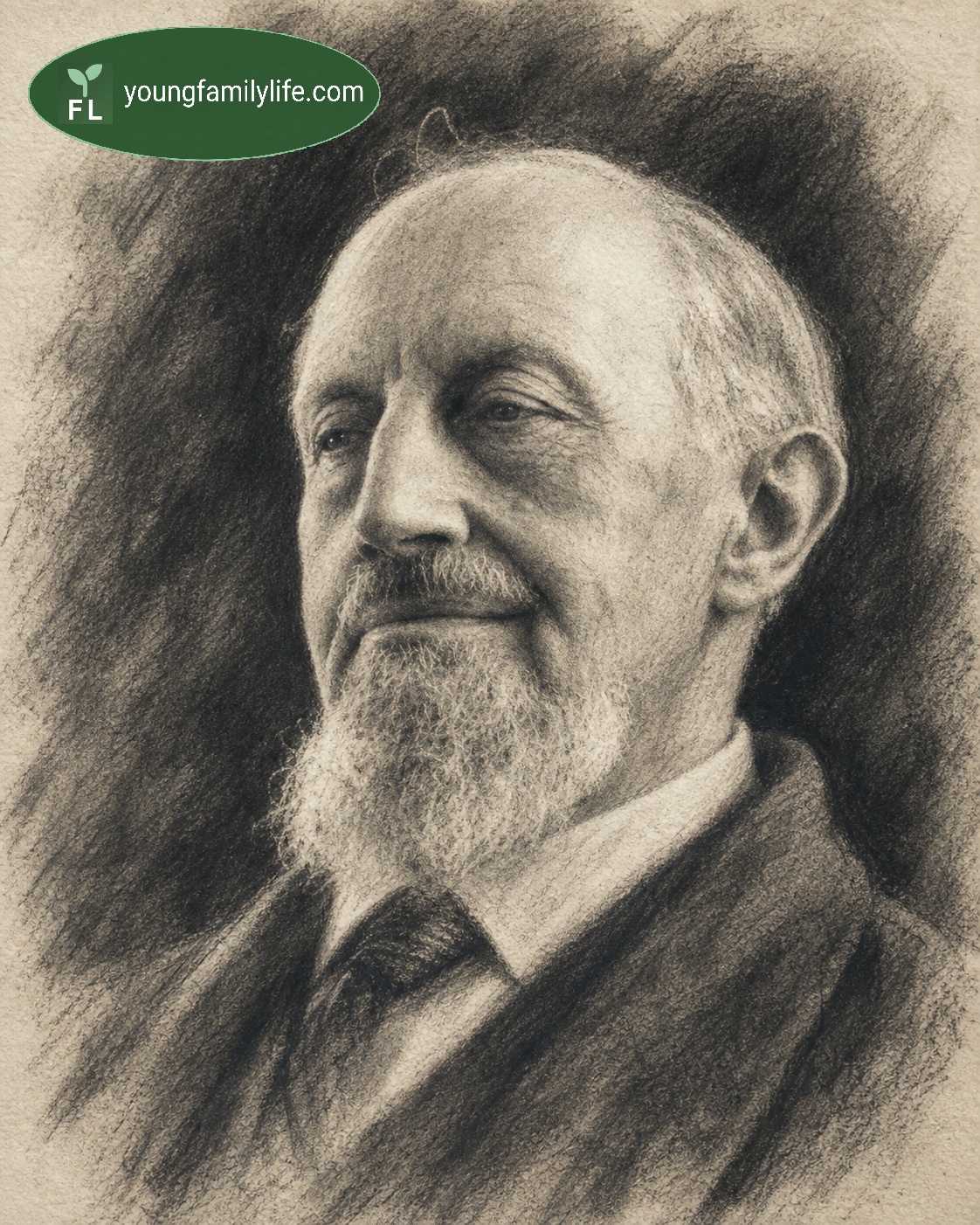
The Life
Roberto Assagioli was born on 27 February 1888 in Venice, into a cultivated Jewish family with intellectual and artistic roots. His mother, Elena Kaula, was a theosophist — a follower of the esoteric spiritual movement founded by Helena Blavatsky — and this early exposure to ideas about human spiritual potential and the evolution of consciousness left a permanent mark on Assagioli's thinking, even as he sought throughout his career to place those ideas on rigorous psychological foundations.
He studied medicine at the University of Florence and then at the Burghölzli clinic in Zürich — the same institution where Jung was working under Bleuler, and where the young Italian encountered psychoanalytic ideas directly and at their source. He was, in fact, the first psychoanalyst to practise in Italy, and his doctoral thesis of 1910 — a critical evaluation of psychoanalysis — established both his deep engagement with Freudian thought and his reasons for moving beyond it. He corresponded with Freud, who expressed the hope that Assagioli would advance the psychoanalytic cause in Italy; by the time that hope was expressed, Assagioli had already decided the framework was insufficient.
He established a small practice in Florence and began publishing the ideas that would become Psychosynthesis — first in the journal Psiche (1912–1915), which he founded and edited, and which closed when the First World War interrupted everything. The interwar years were a period of gradual development and quiet but growing influence. Assagioli treated patients, trained students, corresponded with thinkers across Europe, and refined his model through decades of clinical observation and theoretical elaboration.
His life was interrupted by the Second World War in the most direct possible way. As a Jew in Fascist Italy, he was imprisoned by Mussolini's government in 1940 and held for a month before being released. When Italy fell to the Germans in 1943, he was imprisoned again — this time by the Nazi-aligned authorities — for a period of approximately four months. He spent this time, by his own account, in what he described as sustained psychosynthetic practice: meditation, inner work, the cultivation of joy and equanimity under extreme conditions. The experience did not break him; it confirmed his convictions.
After the war, Assagioli continued to develop Psychosynthesis, establishing the Istituto di Psicosintesi in Florence and corresponding with the leading figures of humanistic and transpersonal psychology — Abraham Maslow, Anthony Sutich, and others — as that movement developed in the United States through the 1960s. He became a co-editor of both the Journal of Humanistic Psychology and the Journal of Transpersonal Psychology, and his work Psychosynthesis: A Manual of Principles and Techniques (1965) brought his ideas to an international audience for the first time.
He continued to work, receive visitors, and write with remarkable energy until the end of his life. He died in Capolona, near Arezzo, on 23 August 1974, at the age of eighty-six — having spent more than sixty years developing a psychology of the whole human being.
The Theory
The Starting Point: Beyond Pathology
Assagioli's departure from Freudian psychoanalysis was not primarily a rejection of its insights but an insistence on its incompleteness. He accepted the reality of the unconscious, the significance of repressed material, and the importance of bringing hidden contents into awareness. What he rejected was the implicit assumption that the goal of psychological work was the restoration of adequate functioning — the removal of neurotic obstruction so that the person could return to the average. His question was different: not what is preventing this person from functioning? but what is this person capable of becoming?
This reorientation placed Psychosynthesis firmly in the humanistic tradition — alongside Maslow's hierarchy of needs and Rogers' person-centred approach — but also beyond it, into what became the transpersonal tradition: the acknowledgement that human experience includes dimensions that exceed the personal biography and the social self.
The Egg Diagram
Assagioli's most distinctive theoretical contribution is his model of the psyche, conventionally represented as an oval or egg shape divided into several regions.
The lower unconscious contains the psychological material most closely connected to the body and to primitive drives — repressed memories, unresolved emotional complexes, the instinctual energies that Freud primarily mapped. This is not a static chamber but an active one: its contents exert upward pressure on the middle zone, and events in conscious life can disturb those depths and bring material surging unexpectedly to the surface.
The middle unconscious is the accessible zone of ordinary psychological functioning — the near-conscious territory of current preoccupations, feelings available for reflection, thoughts and memories that can be brought to awareness with relative ease.
The higher unconscious — or superconscious — is Assagioli's most original proposition, and the one that most clearly separates him from both Freud and Jung. This upper region is the source of what he called the higher qualities of human experience: inspiration, creativity, ethical intuition, the experience of beauty, the drive toward meaning and purpose. It is not a spiritual realm in a metaphysical sense — Assagioli was careful to maintain a psychological rather than theological framework — but it is the dimension of the psyche that reaches toward what the person might become rather than what they have been. It is the source of joy in its fullest sense.
At the centre of the middle zone sits the personal self or "I" — the point of pure self-awareness, distinct from the contents of consciousness, capable of observing thoughts, feelings, and sensations without being wholly identified with them. Above and beyond the personal self, at the apex of the egg, is the Higher Self — the transpersonal centre that connects the individual to something larger than the personal biography, and that Assagioli understood as the source of the deepest integrating impulses in human experience.
Surrounding the entire diagram is the collective unconscious — shared psychological material that connects the individual to the wider human and natural world, in a conception that parallels but does not exactly reproduce Jung's.
Subpersonalities
One of Assagioli's most practically useful concepts is that of subpersonalities — the relatively autonomous psychological configurations that coexist within any individual's psyche. Each subpersonality has its own worldview, emotional tone, body posture, desires, and characteristic way of relating to others. They are not pathological — they are a normal feature of psychological architecture. The critical parent, the frightened child, the competent professional, the playful self, the anxious protector: these and many others may all be present within a single person, becoming dominant in different contexts and in response to different triggers.
The problem arises not from the existence of subpersonalities but from the individual's lack of awareness of them. A person who is identified with a subpersonality — who believes they are the frightened child, or the critical parent, or the competent professional — has lost access to the observing "I" that can recognise the subpersonality for what it is, work with it, and gradually integrate it into a more coherent whole. Psychosynthetic work involves developing precisely this capacity for observation and disidentification — the ability to say "I have this subpersonality, but I am not this subpersonality."
The Will
Assagioli devoted considerable attention to the concept of will — not willpower in the grim, self-overriding sense, but the active, directed quality of the self that enables choice, intention, and movement toward what is valued. He distinguished several aspects of will: the strong will (the capacity for sustained effort), the skilful will (the intelligent direction of effort), the good will (the orientation toward what is genuinely valuable rather than merely gratifying), and the transpersonal will (the alignment of personal will with the deeper purposes of the Higher Self).
This emphasis on will was a direct response to what Assagioli saw as the passivity implicit in psychoanalytic treatment — the idea that the patient is primarily a subject acted upon by forces rather than an agent capable of directing their own development.
Joy as Psychological Necessity
Running through all of Assagioli's work is the conviction that joy — not happiness as a pleasant emotional state, but joy as the experience of being fully alive and moving toward one's deeper nature — is a psychological necessity rather than a luxury. It is not the reward for resolving pathology. It is the direction in which the healthy psyche moves. The will toward synthesis — toward integration, toward meaning, toward the expression of the higher qualities contained in the superconscious — is the engine of psychological growth, and joy is its signal. A person who is moving in the right direction feels it, even when the journey is difficult. A person who has resolved their neurosis but has no direction — the empty, competent adult — does not.
The Legacy
Assagioli's influence is less publicly visible than Freud's or Jung's, but it is pervasive in the fields of psychotherapy, coaching, education, and contemplative practice. Psychosynthesis training programmes operate across Europe, North America, and beyond. The Institute of Psychosynthesis in London has been a significant training centre since the 1970s. His work has been developed and extended by, among others, John Firman and Ann Gila, whose Psychosynthesis: A Psychology of the Spirit remains the most substantial contemporary systematic account of the field.
His concept of subpersonalities has been absorbed — sometimes without attribution — into a wide range of therapeutic approaches, including Internal Family Systems therapy (Richard Schwartz), which operates on very similar principles. His egg diagram provides a map that practitioners from diverse backgrounds find clinically useful precisely because it does not reduce the person to either their pathology or their biology.
His contribution to transpersonal psychology is foundational. His insistence that psychology must account for the full range of human experience — including its heights, not only its depths — opened a space that the positive psychology movement, the mindfulness tradition in therapeutic practice, and the growing literature on flourishing and human potential have continued to develop. The proposition at the core of his work — that the human being is not primarily a system to be repaired but a self striving toward something — is, in the early twenty-first century, more influential than it has ever been.
Perhaps most importantly, Assagioli modelled what he theorised. The account of his time in prison — sustained through inner work, through the cultivation of joy and equanimity under conditions designed to break both — is the most vivid demonstration his own framework ever received. The theory was tested in extremis. It held.
References
Primary Works
Assagioli, R. (1965). Psychosynthesis: A Manual of Principles and Techniques. The Viking Press.
Assagioli, R. (1973). The Act of Will. Viking Adult Publisher.
Biography and Scholarship
Firman, J., & Gila, A. (2002). Psychosynthesis: A Psychology of the Spirit. State University of New York Press.
Firman, J., & Gila, A. (2010). A Psychotherapy of Love: Psychosynthesis in Practice. State University of New York Press.
Ferrucci, P. (1982). What We May Be: Techniques for Psychological and Spiritual Growth through Psychosynthesis. J. P. Tarcher.
Hardy, J. (1987). A Psychology with a Soul: Psychosynthesis in Evolutionary Context. Routledge & Kegan Paul.
Rowan, J. (1990). Subpersonalities: The People Inside Us. Routledge.
Topics: #Assagioli #Psychosynthesis #Subpersonalities #Joy #TranspersonalPsychology #EggDiagram #TheWill #HumanisticPsychology #PsychologicalTheory #FamilyLife #YoungFamilyLife
Copyright Notice
© 2026 Steve Young and YoungFamilyLife Ltd. All rights reserved.
This essay was developed collaboratively using AI assistance to research academic sources and refine content structure, while maintaining the author's original voice, insights, and "Information Without Instruction" philosophy. No part of this essay may be reproduced, distributed, or transmitted in any form or by any means without the prior written permission of the copyright holders, except in the case of brief quotations embodied in critical reviews and certain other noncommercial uses permitted by copyright law.
For permission requests, contact: info@youngfamilylife.com