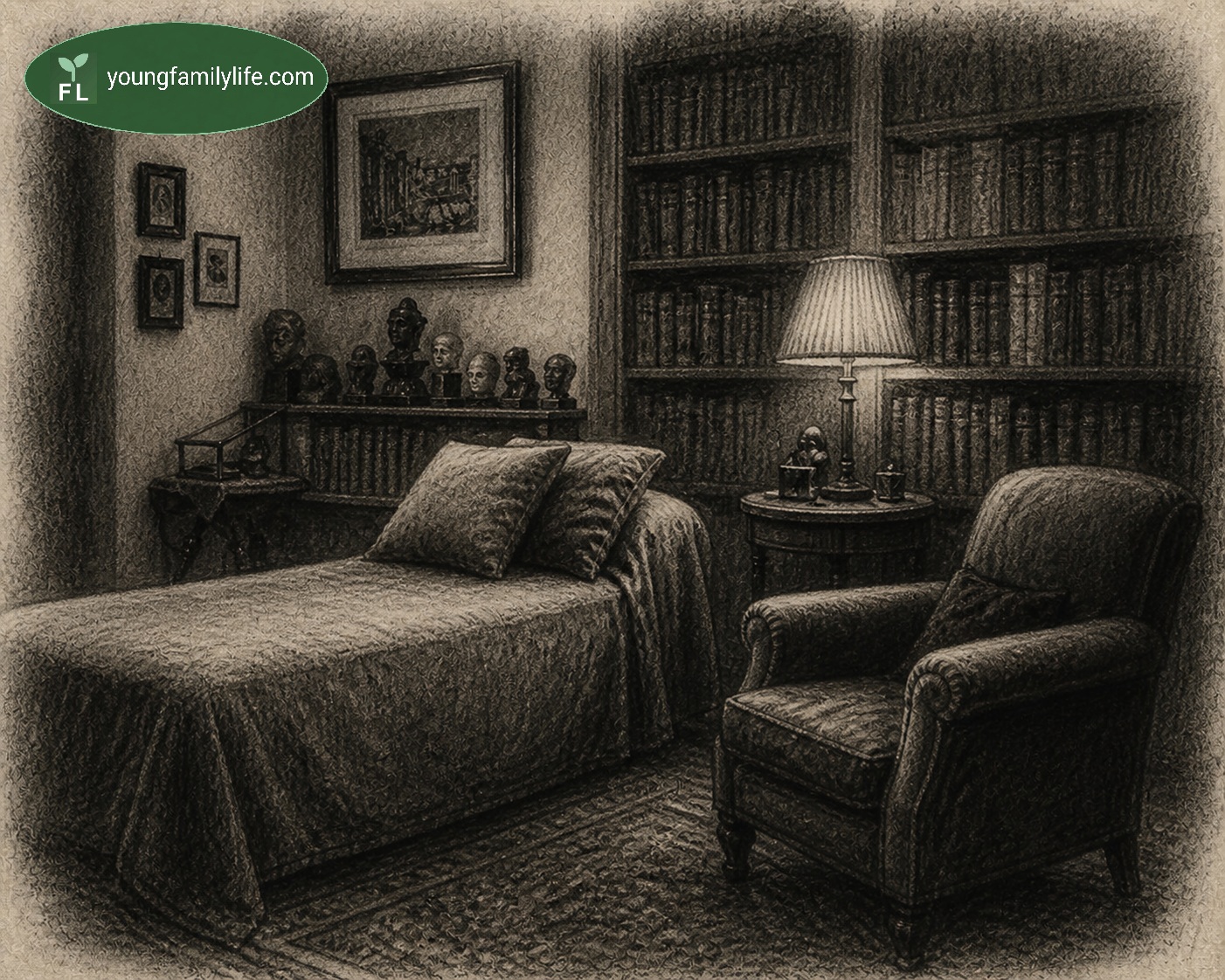
What Freud actually said — stripped of the mythology
Sigmund Freud is one of the most famous thinkers in history and one of the most misrepresented. The popular version — obsessed with sex, seeing everything as a symbol, blaming everything on the mother — is a caricature that has largely displaced the actual ideas. What Freud proposed, at its core, was something genuinely radical and still underappreciated: that people do not fully know their own minds, and that what they do not know is not neutral. It shapes them.
The concept at the centre of Freud's work is the unconscious — not a vague sense that some thoughts are hard to access, but a systematic claim that a significant portion of mental life occurs outside awareness, and that this hidden material actively drives behaviour, feeling, and relationship in ways the individual cannot observe directly. The person who finds themselves inexplicably angry at their partner, inexplicably frightened by a particular situation, inexplicably drawn to repeating a pattern they have tried many times to break — is, in Freud's account, not irrational. They are responding to something real. They simply cannot see what it is.
This proposition, developed across four decades of clinical practice and an extraordinary body of writing, forms the foundation of every psychotherapeutic tradition that has followed. It is so embedded in contemporary culture that its origin is barely remembered. But its practical implications for family life are as live today as they were in Freud's Vienna consulting room.
How the mind manages what it cannot bear to know
Freud's structural model of the psyche — the id, the ego, and the superego — gives a working picture of how the mind holds itself together under pressure. The id contains the raw drives: the demand for pleasure, the push toward aggression, the insistence of appetite. The superego carries the internalised voice of authority — the prohibitions and expectations absorbed from parents, culture, and social life. The ego negotiates between these two forces and the demands of external reality, trying to maintain a workable balance.
What makes this model useful, rather than merely conceptual, is what it says about the cost of that negotiation. When the ego cannot manage the pressure — when the demands of the id or the superego become too intense, or when external circumstances become too threatening — it deploys defence mechanisms: unconscious strategies that reduce the immediate pressure by keeping certain material out of awareness. Repression pushes the unbearable memory or wish below the threshold of consciousness. Projection attributes one's own unacceptable feelings to someone else. Displacement redirects an impulse from its real target to a safer one.
These are not failures. They are adaptations. They allow the person to function in circumstances that would otherwise be overwhelming. But they carry costs. Repressed material does not disappear — it persists, exerting pressure in indirect ways. The defended-against feeling shows up elsewhere: in the body, in relationships, in the pattern of choices made and avoided. Freud's clinical observation was that what cannot be expressed directly will find another route.
What the parent brings into the room without knowing it
For families, one of Freud's most practically significant observations is what he called the repetition compulsion — the tendency to re-enact, in current relationships, dynamics and experiences from the past that were never fully resolved. This is not a conscious process. The parent who finds themselves responding to their child's distress with a coldness they do not intend, or a fury they cannot account for, or a helplessness that seems disproportionate to the situation — is often, in Freud's account, responding not to the child in front of them but to something much older. A scene from their own childhood. A feeling they learned, long ago, to manage by closing down.
Freud called this the return of the repressed. What was buried does not stay buried. It surfaces — in the precisely wrong moment, in the relationship least equipped to absorb it, wearing a contemporary face that conceals its real origin.
The implication for family life is not guilt — it is recognition. The parent who shouts in a way they regret, or withdraws when closeness is needed, or imposes a standard of self-control on their child that no child could meet — may be passing on something they received, rather than choosing something they value. Understanding that does not excuse it, but it does change what it is. It moves from a moral failure to a psychological one — and psychological things, unlike moral ones, can be worked with.
What understanding alone does not do
Freud's framework is, ultimately, one of excavation. Its power lies in uncovering what is hidden, tracing it to its source, and bringing it into the light of conscious awareness where it can be known rather than merely repeated. The method is the talking cure — the patient speaks, the practitioner listens with trained attention, and meaning gradually emerges from what had been formless pressure.
This is a genuine and important contribution. But it has a ceiling that Freud himself acknowledged, late and quietly: understanding is not the same as liberation. A person can know, with considerable precision, why they behave as they do — can trace the history, name the mechanism, account for the pattern — and still find themselves enacting it. Insight is a necessary condition for change; it is not always a sufficient one.
What Freud's framework maps with great care is the downward direction: the depths, the pressure from below, the hidden life that shapes the visible one. What it is less equipped to address is the question of direction — what the person is moving toward, as distinct from what they are moving away from. That question was taken up by the thinkers who came after him.
Anna Freud — the legacy continued and extended
Sigmund Freud's youngest daughter, Anna Freud (1895–1982), occupies a particular place in this story. She is both his biological heir and an independent theorist of considerable standing — and the distinction between those two things matters.
Anna Freud entered psychoanalytic practice under her father's direct influence, was analysed by him, and remained his closest intellectual companion until his death in 1939. She carried the Freudian tradition to London after the family fled Vienna under Nazi annexation, and spent the rest of her long career building and refining psychoanalytic work with children — a domain her father had largely theorised about but not directly practised.
Her most significant theoretical contribution was the systematic elaboration of defence mechanisms. Where Sigmund Freud had identified and described them, Anna Freud organised them into a coherent framework in The Ego and the Mechanisms of Defence (1936) — a work that remains clinically foundational. She identified and named the full range of defences the ego employs: not only repression, projection, and displacement, but regression, reaction formation, intellectualisation, sublimation, and several others. This was not merely a catalogue. It was a map of the ways people protect themselves from what they cannot bear — and, crucially, of what it costs them to do so.
For families, Anna Freud's contribution is perhaps most directly felt in the field of child development and child psychoanalysis. Her work at the Hampstead War Nurseries during the Second World War, caring for children separated from their parents, generated observations about attachment, loss, and the psychological effects of separation that directly influenced John Bowlby's attachment theory — one of the most practically significant bodies of research in child development.
What this leaves families with
The vocabulary Freud created — unconscious, repression, defence mechanisms, the Freudian slip, the id, the ego — is now so thoroughly part of everyday language that most people who use these words have no idea they are drawing on a specific theoretical framework developed by one man in one city between 1890 and 1939. That is perhaps the most accurate measure of how completely his ideas restructured the way the modern world thinks about itself.
For families, the most enduring practical legacy is the permission to take the invisible seriously. The recognition that a child's apparently inexplicable behaviour has a logic — even when the child cannot access that logic themselves. The understanding that the parent brings their own history into every interaction, whether they intend to or not. The proposition that what is not spoken does not thereby cease to exist — that the unacknowledged grief, the unexpressed anger, the love that was never named, all continue to operate in the space between people, shaping what is possible in ways neither person can fully see.
Families who understand this do not necessarily do things differently. But they tend to ask different questions. Not only: what is my child doing? But: what might my child be carrying? Not only: why did I react that way? But: what was I actually responding to? Those questions do not have easy answers. But asking them opens something that the surface-level instruction to simply behave better cannot reach.
Topics: #InOtherWords #Freud #AnnaFreud #Psychoanalysis #Unconscious #FamilyLife #ParentingResearch #DefenceMechanisms #RepetitionCompulsion #ChildDevelopment #YoungFamilyLife #FamilyPsychology
Related YFL Content
In Other Words: Jung's Legacy in Use — the companion IOW piece on analytical psychology: shadow, individuation, and what Jung's framework leaves for families navigating complexity and difficulty.
In Other Words: Assagioli's Legacy in Use — the third piece in the suite: what Psychosynthesis left behind, and the question of joy as a psychological necessity rather than a reward.
Freud, Jung, and Assagioli — A Public Debate — all three in direct argument: the motion "Today's young people should grow up, pull themselves together and be good," chaired by Claude.
The Nervous System We Were Given — the intergenerational transmission Freud identified: how parents bring their own history into every interaction, examined through neuroscience and developmental psychology.
Copyright Notice
© 2026 Steve Young and YoungFamilyLife Ltd. All rights reserved.
"In Other Words" is a copyrighted content format of YoungFamilyLife Ltd.
The information in this piece is based on established research and theory. Full academic sources, references, and evidential detail are available in the linked YoungFamilyLife essays.
This essay was developed collaboratively using AI assistance to research academic sources and refine content structure, while maintaining the author's original voice, insights, and "Information Without Instruction" philosophy. No part of this essay may be reproduced, distributed, or transmitted in any form or by any means without the prior written permission of the copyright holders, except in the case of brief quotations embodied in critical reviews and certain other noncommercial uses permitted by copyright law.
For permission requests, contact: info@youngfamilylife.com